
Why Performance Marketing Matters
I’ve seen online business and digital marketing change from the ground up.
When I started my business, the online market looked very different from what it does today. The term ecommerce was not part of everyday business language in the way it is now. Online marketplaces such as Amazon and Flipkart were becoming important places for businesses to reach customers, while websites were still largely made up of static pages.
Over time, my own business moved from a static website to OpenCart and later to Shopify. In 2015, we started selling on Amazon, which became an important source of customers for the business.
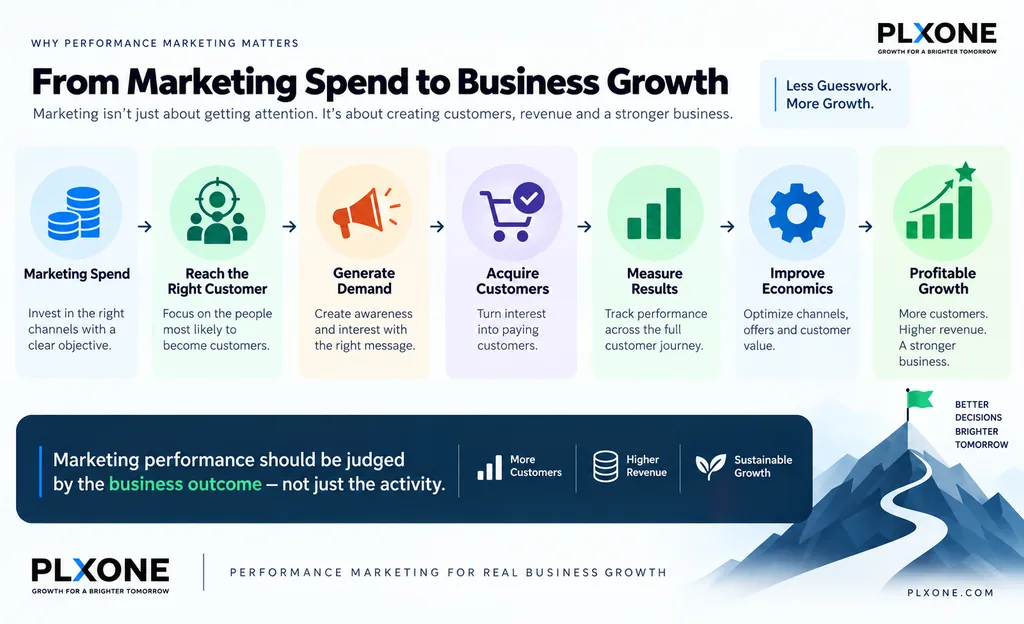
I started the business with around ₹15,000 and eventually grew it to around ₹1 crore in monthly revenue. Along the way, I had to learn and manage almost every part of the business myself—from cash flow and inventory to finding reliable vendors, managing employees, and understanding which products were driving the business.
As technology and digital marketing evolved, I also started running Google Ads myself. At that time, I did not have a deep understanding of how the platform worked. I made mistakes and lost some of the money I had worked hard to earn.
That experience taught me an important lesson: putting money into advertising without understanding how the system works can turn a marketing investment into wasted money.
Learning resources were also very different at that time. There wasn’t the amount of YouTube content, courses, and marketing advice available today. Google’s own documentation and help resources became an important source for learning how the platform actually worked.
That journey shaped the way I look at performance marketing today. It is not simply about running Google Ads, Meta Ads, or getting more clicks. It is about understanding the customer, choosing the right marketing channels, measuring meaningful outcomes, and using what the data tells you to make better decisions.
This guide explains performance marketing from that perspective—how it works, how businesses measure it, how it connects with customer acquisition and profitability, and when increasing marketing spend actually makes sense.
Before we go deeper into performance marketing, let’s first establish the foundation it is built on: what marketing is and how it creates value for a business and its customers.
Before We Learn Performance Marketing: What Is Marketing?
When I started working with online advertising, I used to think about marketing mainly in terms of promotion. But running a business taught me that marketing starts much earlier than the advertisement.
Before a business spends money to promote something, it needs to understand who the customer is, what problem the customer has, what the business is offering, and why that customer should choose it.
Think about it from the customer’s side.
A person has a need or a problem. A business offers a product or service that may solve that problem. Marketing helps the business understand that customer, communicate the value of the offer, reach the right people, make the buying process easier, and continue the relationship after the purchase.
So, in simple terms, marketing connects:
Customer Need → Business Value → Communication → Purchase → Customer Relationship
This is the foundation we need before moving into performance marketing.
Why?
Because advertising is only one part of marketing.
You can bring thousands of people to a website through Google Ads or Meta Ads, but if the product, offer, customer experience, or buying process is weak, more traffic may not solve the real problem.
That is why I want to start this Performance Marketing guide with the basics. Once we understand what marketing is trying to achieve, it becomes much easier to understand where performance marketing fits, what it can measure, and what it cannot fix.
What Is Performance Marketing?
I used to think that getting an advertisement in front of people was the main job. Running Google Ads myself taught me that the more important question is what happens after someone sees or clicks that advertisement.
Did the customer buy?
How much did it cost to acquire that customer?
How much revenue did the customer generate?
And, most importantly, did the result make business sense?
That is the basic idea behind performance marketing.
Performance marketing is a measurable approach to marketing where businesses define the outcomes they want, track what happens, and use the results to improve their marketing decisions.
Those outcomes can be different depending on the business. They may include:
- Leads
- Purchases
- New customers
- Revenue
- App installs
- Other measurable conversions
For an ecommerce business, for example, getting thousands of clicks may look like good performance. But clicks alone don’t tell you whether the business is growing. You need to understand what happened after those clicks and what the resulting customers were worth to the business.
This is why performance marketing is not simply running Google Ads or Meta Ads. Those are channels. Performance marketing is the broader process of connecting marketing activity with measurable outcomes, evaluating the results, and using what you learn to make better decisions.
And there is another important point: good campaign performance does not automatically mean profitable business growth.
A campaign can generate conversions while still producing poor economics if customer acquisition costs are too high, margins are too low, or customers do not come back.
That distinction is important throughout this guide. We are not looking at performance marketing only as a way to generate traffic or conversions. We are looking at it as a way to understand whether marketing investment is creating meaningful business outcomes.
Performance Marketing vs Digital Marketing
When I look back at how my own business evolved, I can see that digital marketing was never just about advertising. We moved from a static website to OpenCart and later Shopify. We also used marketplaces such as Amazon to reach customers, and later started using Google Ads.
All of these activities helped us reach customers online, but they did not work in the same way. This is an important distinction when trying to understand digital marketing and performance marketing.
What is digital marketing?
Digital marketing is the broader field of marketing through digital channels. It includes the different ways a business can reach, communicate with, and build relationships with customers online.
These can include:
- Websites
- Search engines and SEO
- Social media
- Email marketing
- Content marketing
- Online advertising
- Marketplaces
Not every digital marketing activity is designed to produce an immediate, directly measurable sale. Some activities build visibility, awareness, trust, or future demand.
What is performance marketing?
Performance marketing puts greater emphasis on measurable outcomes. Instead of looking only at whether people saw or interacted with a marketing activity, we want to understand what happened as a result.
For example:
Did someone become a lead?
Did they make a purchase?
How much did it cost to acquire them?
How much revenue did they generate?
Was the result financially worthwhile?
This is where metrics such as conversion rate, CPA, CAC, ROAS, and revenue become important.
So, what is the difference?
The simplest way to understand the relationship is:
Digital marketing is the broader field. Performance marketing is an outcome-focused approach to marketing that emphasizes measurement, analysis, and optimization.
For example, SEO and content marketing may take time to build organic visibility and demand. Google Ads and Meta Ads can often provide more immediate and measurable campaign data. Both can be part of a digital marketing strategy, but the way we evaluate them may be different.
This distinction is important because performance marketing is not simply another name for digital marketing, and it is not limited to paid advertising.
The real focus is on connecting marketing activity with measurable outcomes and then using what we learn to make better decisions.
How Performance Marketing Works
A campaign doesn’t begin when we open Google Ads or Meta Ads. By that point, several important decisions should already have been made.
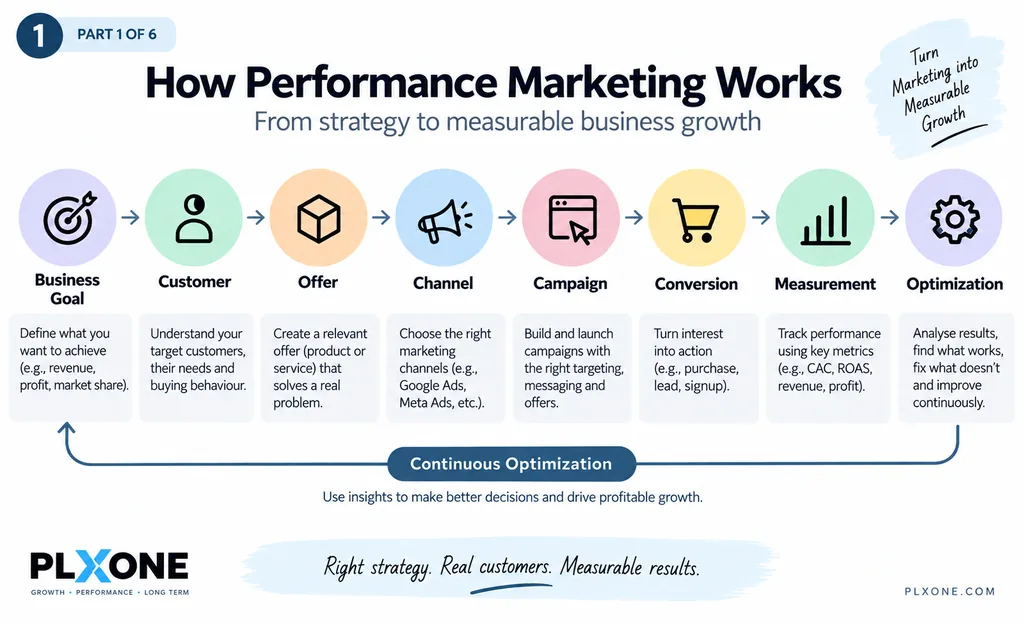
A simple way to understand the process is:
Business Goal → Customer → Offer → Channel → Campaign → Conversion → Measurement → Optimization
Let’s walk through it with a simple ecommerce example.
1. Start With a Business Goal
Before opening an advertising platform, we need to know what the business is actually trying to achieve.
Suppose an ecommerce business wants to acquire more customers for a particular product.
The goal isn’t simply to get more traffic. The business needs to know what kind of customer it wants, how much it can reasonably spend to acquire that customer, and what a successful result looks like.
That gives the campaign a business objective instead of just an advertising objective.
2. Understand the Customer
Next, we need to understand who we are trying to reach.
Are these people already searching for the product?
Have they shown interest in something similar?
Are they existing website visitors?
Are they previous customers?
The answer influences which channel makes sense.
For example, Google Ads can be useful when people are actively searching for a product or solution. Meta Ads can be useful for reaching and retargeting audiences based on signals available on the platform.
The objective isn’t to reach the largest possible audience.
It is to reach people who are more likely to become customers.
3. Make Sure the Offer Makes Sense
An advertisement can get someone’s attention, but the offer has to give that person a reason to act.
The offer could involve the product itself, pricing, a bundle, free shipping, a discount, or another clear customer benefit.
This is important because advertising cannot compensate for every weakness in a business.
If the product or offer doesn’t make sense to the customer, increasing the advertising budget may simply increase the amount of money being spent without solving the real problem.
4. Choose the Right Channel
Once we know who we’re trying to reach and what we want to achieve, we can decide which channel makes the most sense.
The choice might be Google Ads, Meta Ads, another paid channel, or even an organic channel, depending on the situation.
The channel is a means to reach the customer.
It should not become the strategy itself.
5. Run the Campaign
Now the campaign can be built.
This may involve decisions around:
- Audience or search intent
- Ad message and creative
- Budget
- Bidding
- Landing page
- Conversion goal
- Tracking
At this point, the campaign starts generating data.
But the first set of numbers is not the final answer.
6. Measure What Actually Happened
Suppose the campaign generated:
- 1,000 clicks
- 150 purchases
- ₹1,50,000 in attributed sales
We can calculate several performance metrics from this data, but we still need to ask a more important question:
Did those results make business sense?
We need to understand the conversion rate, Customer Acquisition Cost (CAC), Return on Ad Spend (ROAS), and eventually the value and profitability of the customers acquired.
This is where performance marketing becomes useful.
We aren’t looking at campaign activity in isolation. We are trying to understand what the activity actually produced.
7. Learn and Optimize
The campaign doesn’t end when we get the first set of results.
We look at the data and ask:
- Which audience performed better?
- Which message generated more conversions?
- Where are potential customers dropping out?
- What is driving the highest customer acquisition cost?
- Which products or offers are performing better?
- Should we change the budget or campaign structure?
Then we make a change, measure the new result, and learn again.
Measure → Identify → Investigate → Optimize → Measure again
That continuous feedback loop is at the heart of performance marketing.
The Important Part
Performance marketing is therefore not just about buying traffic or generating conversions.
It is about connecting marketing activity with business outcomes, understanding what the data is telling us, and using that information to make better decisions.
And that is why a campaign can have good-looking numbers and still be a poor business decision.
A strong click-through rate or ROAS does not automatically mean the business is acquiring profitable customers.
The deeper we go into performance marketing, the more important this distinction becomes.
Performance Marketing Channels
Choosing a marketing channel is not about following whatever platform is popular at the moment. The better question is: where are the potential customers, and what can that channel realistically help the business achieve?
From my own experience, this became clearer as the business moved through different ways of reaching customers—from marketplaces such as Amazon to our own website and later Google Ads.
Performance marketing can use different channels depending on the business model, customer journey, and objective.
Google Ads
Google Ads can help businesses reach people who are actively searching for a product, service, or solution.
For example, someone searching for “running shoes for beginners” already has a specific need. A business selling suitable running shoes can use search advertising to appear when that demand exists.
Meta Ads
Meta Ads, including advertising on Facebook and Instagram, can help businesses reach and retarget audiences based on signals available through the platform.
For example, an ecommerce brand can introduce a product to a relevant audience and later reconnect with people who visited the website but didn’t purchase.
Display Advertising and Retargeting
Display advertising can help businesses reach people across websites and digital properties.
Retargeting can be used to reconnect with people who have already interacted with a business.
For example, someone visits a product page without purchasing. A retargeting campaign may give the business another opportunity to bring that person back.
Affiliate Marketing
In affiliate marketing, businesses work with partners who promote their products or services and receive compensation based on defined actions or outcomes.
This can allow businesses to extend their reach while connecting partner activity with measurable results.
Other Measurable Channels
Depending on the business model, performance marketing can also involve other digital acquisition channels.
The important point is that the channel itself does not automatically make something performance marketing.
What matters is how the business uses the channel:
Objective → Audience → Campaign → Conversion → Measurement → Optimization
A business may use Google Ads, Meta Ads, or another channel, but if it doesn’t have a clear objective, reliable measurement, and a way to learn from the results, simply spending money on that channel does not create a performance marketing system.
The channel should serve the strategy—not become the strategy.
That is why channel selection should come after understanding the customer and business objective, not before.
Performance Marketing Strategy
A campaign can be technically well executed and still be the wrong campaign for the business.
Strategy is what connects the business objective to the decisions that follow: who we want to reach, what we want to offer, where we should reach them, how much we can reasonably invest, and how we will judge the result.
Before putting money into a campaign, I would want clear answers to a few questions:
- What are we actually trying to achieve?
- Who are we trying to reach?
- What are we offering them?
- Where are they most likely to respond?
- What can the business reasonably spend to acquire them?
- How will we decide whether the result is good enough?
These questions give the campaign a business reason before we get into the advertising platform.
Start With the Business Objective
The first step is to define what the business wants the marketing activity to achieve.
It could be:
- Acquiring new customers
- Generating qualified leads
- Increasing sales of a particular product
- Launching a new product
- Improving customer acquisition efficiency
- Increasing revenue
“Get more sales” may be a useful starting point, but it doesn’t tell us enough to build a strategy.
We need to understand what kind of sales the business wants and what makes those sales valuable.
Choose the Right Channel
Only after understanding the objective and the customer should we decide where to reach them.
Google Ads may make sense when customers are actively searching for a product or solution. Meta Ads may make sense when we need to reach or reconnect with relevant audiences. Other channels may make more sense in different customer journeys.
The important point is that the channel follows the strategy—not the other way around.
Decide How Success Will Be Measured
Before launching the campaign, we should know how we will judge its performance.
Depending on the objective, this could involve:
- Conversion rate
- Cost Per Acquisition (CPA)
- Customer Acquisition Cost (CAC)
- Revenue
- Return on Ad Spend (ROAS)
- Customer value
The important thing is not to collect every number available in an advertising dashboard.
It is to identify the metrics that actually help us answer the business question.
Launch, Investigate and Optimize
A performance marketing strategy doesn’t end when the campaign goes live.
Once data starts coming in, we need to understand what is working, what isn’t, and why.
Suppose one audience is generating customers at a much higher acquisition cost than another.
The answer isn’t automatically to increase the budget for the better-performing audience.
We first need to understand what the data is telling us and whether the difference is meaningful.
The process becomes:
Measure → Identify → Investigate → Optimize → Measure again
For me, this is the important part of performance marketing strategy: the campaign should be a result of the business thinking that happens before it, not a substitute for that thinking.
A good strategy gives us a reason for every major decision—from the customer we target and the offer we present to the channel we choose and the metrics we use to judge the result.
Customer Acquisition & Performance Marketing
Getting a customer is one thing. Getting a customer who creates enough value for the business is another. I learned this while building my own business because every new customer came with a real cost—money spent on marketing, inventory tied up in the business, fulfilment, and the effort required to serve that customer.
That changed the way I looked at customer acquisition. I couldn’t simply ask how many customers we were getting. I had to understand what those customers were costing us and what value they were creating for the business.
That is why, when we talk about customer acquisition in performance marketing, the real question is:
How much are we spending to acquire a customer, and what value does that customer bring to the business?
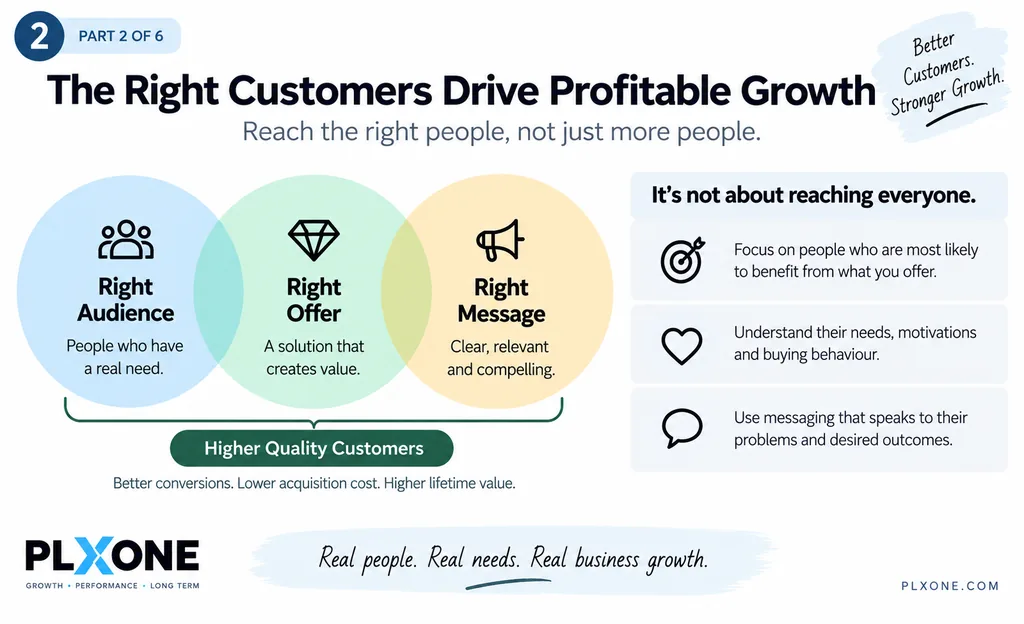
What Is Customer Acquisition?
Customer acquisition is the process of attracting potential customers and converting them into paying customers.
In performance marketing, this can involve several stages:
Audience → Visit → Enquiry/Action → Conversion → New Customer
For an ecommerce business, for example, a person may see an advertisement, visit a product page, add the product to the cart, complete the purchase, and become a customer.
Performance marketing helps us measure what is happening at these stages.
Customer Acquisition Cost (CAC)
One of the most important numbers here is Customer Acquisition Cost (CAC).
CAC tells us how much the business spends, on average, to acquire a new customer.
For example, suppose a business spends ₹1,00,000 on marketing and acquires 200 new customers.
The average acquisition cost would be:
₹1,00,000 ÷ 200 = ₹500 per customer
But ₹500 CAC doesn’t automatically tell us whether the acquisition is good or bad.
A ₹500 CAC may be acceptable for one business and completely unsustainable for another.
Why?
Because the value of the customer can be very different.
CAC Needs Business Context
Imagine two businesses both acquire customers at ₹500 each.
Business A
- Customer Acquisition Cost: ₹500
- Average first purchase: ₹700
Business B
- Customer Acquisition Cost: ₹500
- Average first purchase: ₹2,500
At first glance, both businesses have the same CAC. But the economics behind the acquisition are very different.
And even this comparison is incomplete.
We may still need to consider:
- Product cost
- Gross margin
- Shipping and fulfilment
- Discounts
- Payment costs
- Repeat purchases
- Customer Lifetime Value
- Other costs associated with serving the customer
This is why customer acquisition should not be judged only by the number of customers acquired or the CAC alone.
Performance Marketing and Customer Quality
Performance marketing gives us the ability to compare campaigns, audiences, channels, and offers based on measurable results.
But a campaign that produces more customers isn’t automatically the better campaign.
Suppose Campaign A generates 100 customers and Campaign B generates 150 customers.
Campaign B appears better if we look only at customer volume.
But what if Campaign B requires much higher acquisition costs or brings customers who rarely purchase again?
The answer can change completely.
This is where metrics such as CAC, Customer Lifetime Value (LTV), conversion rate, and ROAS become useful. They help us move from simply counting customers to understanding the economics of customer acquisition.
The Bigger Picture
For me, this is one of the most important ideas in performance marketing:
The goal isn’t simply to acquire more customers. The goal is to acquire customers in a way that makes business sense.
Performance marketing gives us the data to understand that process, but the data still needs to be interpreted in the context of the business.
That is why customer acquisition and business economics should be considered together, rather than treating advertising performance as a separate activity from the business itself.
Performance Marketing Metrics
When you run a business yourself, you quickly learn that numbers can tell very different stories depending on which number you are looking at. I experienced this while managing everything from cash flow and inventory to customer acquisition and advertising.
The same thing happens in performance marketing.
An advertising dashboard can show you clicks, impressions, conversions, cost, revenue, and many other numbers. But looking at all these numbers doesn’t automatically tell you whether the marketing is actually working.
The first thing I try to understand is what question each metric is helping me answer.
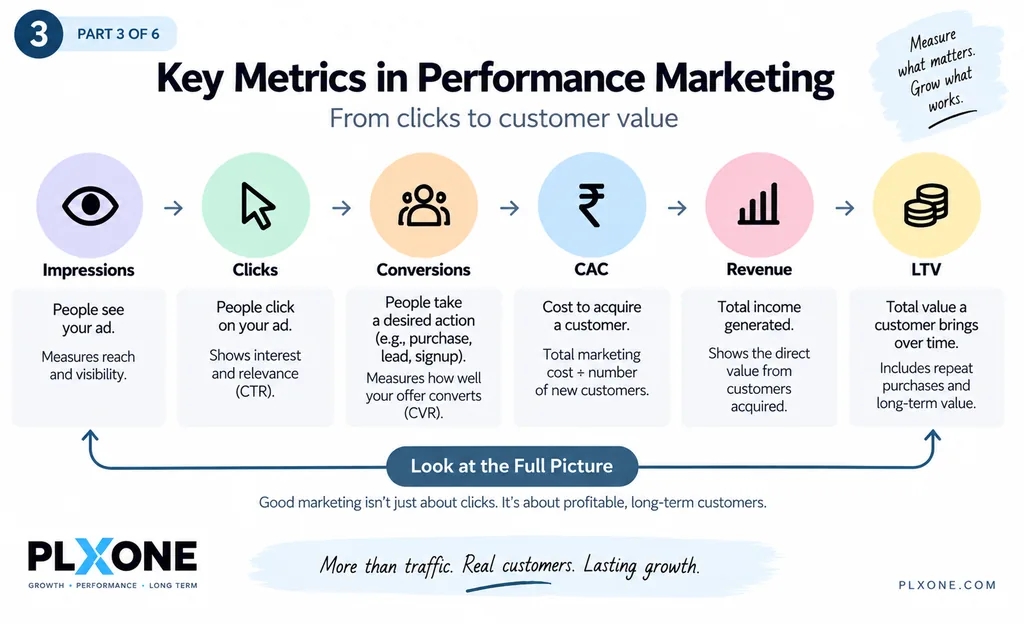
1. Are People Responding to the Campaign?
At the beginning of the customer journey, we have metrics such as:
- Impressions — how many times an advertisement was shown.
- Reach — how many people saw the advertisement.
- Clicks — how many times people clicked.
- Click-Through Rate (CTR) — the percentage of impressions that resulted in clicks.
- Cost Per Click (CPC) — the average cost of each click.
These numbers help us understand whether people are seeing and responding to the advertisement.
But there is an important limitation:
A click is not a customer.
A campaign can generate thousands of clicks and still produce very few sales.
2. Are People Taking the Desired Action?
Once people interact with the campaign, we want to know what happens next.
For an ecommerce business, the desired action may be a purchase. For another business, it could be a lead, enquiry, registration, or another conversion.
Conversion Rate helps us understand how effectively people are moving from an interaction to the desired action.
For example, suppose 1,000 people visit a product page and 50 purchase. That tells us something about how effectively that traffic is converting.
We can then look at metrics such as:
- Cost Per Acquisition (CPA) — how much it costs to generate a defined conversion.
- Customer Acquisition Cost (CAC) — the average cost of acquiring a new customer.
These two terms are related, but they are not always interchangeable. A conversion does not necessarily mean that a new customer has been acquired.
3. What Are We Getting Back From Advertising?
Once we know that the campaign is generating conversions, we can look at the revenue associated with those conversions.
One commonly used metric is Return on Ad Spend (ROAS).
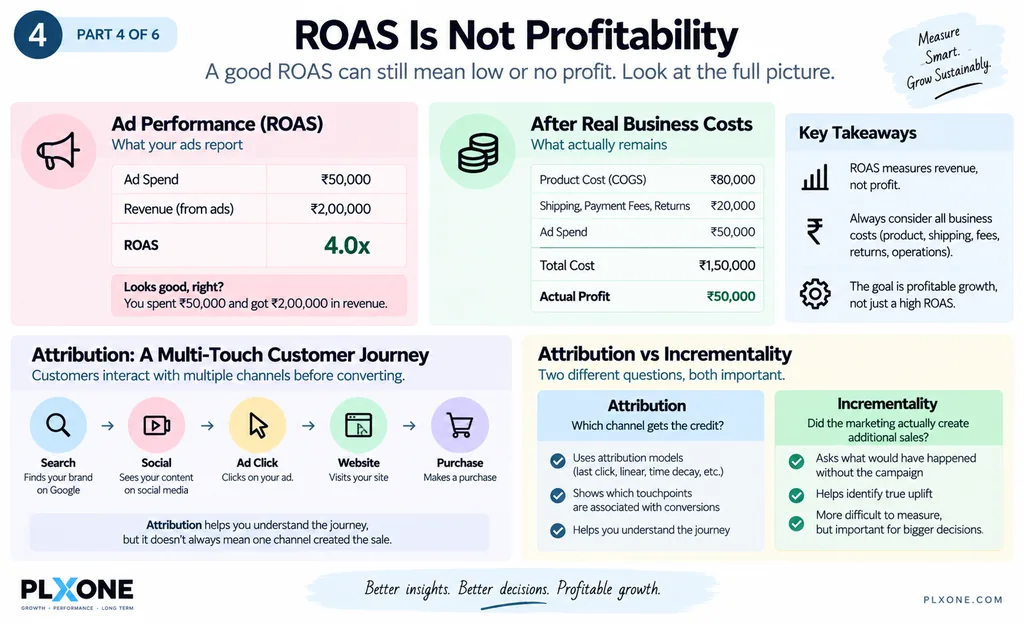
For example, suppose a campaign spends ₹50,000 on advertising and generates ₹2,00,000 in attributed sales.
That gives us a ROAS of 4.
At first glance, that sounds good.
But this is where I would stop before calling the campaign profitable.
ROAS tells us about the relationship between attributed revenue and advertising spend. It does not tell us the complete profit made by the business.
We may still have product costs, shipping, discounts, payment fees, salaries, technology costs, and other expenses.
So a strong ROAS does not automatically mean strong business profitability.
4. What About Marketing Efficiency Ratio (MER)?
ROAS usually looks at the relationship between attributed revenue and advertising spend.
MER takes a broader view.
It compares total revenue with total marketing spend, rather than asking which individual campaign or platform received credit for the revenue.
For example, if a business generates ₹10 lakh in total revenue and spends ₹2 lakh across its marketing activities, its MER would be:
₹10,00,000 ÷ ₹2,00,000 = 5
MER can therefore provide a broader view of marketing efficiency at the business level.
But just like ROAS, MER is not a profit metric.
It doesn’t automatically account for product costs, fulfilment, salaries, overheads, or other business expenses.
So I would use it as another piece of the picture—not as a replacement for understanding the actual economics of the business.
5. What Is the Customer Worth to the Business?
This is where we move beyond the advertising platform and start looking at the customer from a business perspective.
Metrics such as:
- Customer Acquisition Cost (CAC)
- Customer Lifetime Value (LTV)
- Average Order Value (AOV)
- Gross Margin
- Contribution Margin
- Repeat Purchase Rate
can help us understand the economics behind customer acquisition.
For example, acquiring a customer for ₹500 may look expensive if we only look at the first transaction.
But if that customer continues buying from the business, the economics can look very different.
The opposite can also happen. A campaign may produce customers at a low CAC, but if those customers rarely purchase again or generate very little contribution, the acquisition may not be as attractive as it first appears.
Don’t Let One Metric Make the Decision
This is where performance marketing metrics can become misleading.
A campaign can have:
- Better CTR but a lower conversion rate.
- Lower CPC but fewer customers.
- Higher ROAS but lower overall revenue.
- Lower CAC but lower-value customers.
So I don’t believe there is one “best performance marketing metric.”
The right metric depends on what the business is trying to achieve and which part of the customer journey we are evaluating.
The purpose of performance marketing measurement is therefore not to make every number look better.
It is to understand what each number is telling us, what it is not telling us, and how those numbers connect to the actual business outcome.
That is the difference between simply reading an advertising dashboard and actually using performance marketing data to make better business decisions.
Measuring Performance Marketing
Having the right metrics is only useful if we can trust the information behind them.
A business may have a dashboard full of clicks, conversions, revenue, and acquisition costs. But before using those numbers to make decisions, we need to know whether they are being measured consistently and whether they represent what we think they represent.
That means looking beyond the numbers themselves.
Start With the Business Question
Measurement should begin with the question we are trying to answer.
Are we trying to understand:
- whether a campaign is generating new customers?
- whether acquisition is becoming more expensive?
- whether a particular channel is contributing to revenue?
- whether customers acquired through advertising are creating enough value?
The question determines what needs to be measured.
We don’t need to track everything simply because a platform makes the data available.
Make Sure the Conversion Is Being Measured Correctly
A conversion is only useful if we can reasonably trust that it happened and that it has been recorded correctly.
Depending on the business, this may involve measuring:
- Purchases
- Leads
- Enquiries
- Sign-ups
- Calls
- Other defined business outcomes
If tracking is incomplete or incorrectly configured, the resulting numbers can lead to the wrong conclusions.
Better measurement starts with a clear definition of what counts as a meaningful business outcome.
Connect Marketing Data With Business Data
Advertising platforms can tell us what happened within their measurement systems.
But the business may have information that the advertising platform cannot fully capture:
- Actual orders
- Revenue
- Refunds and cancellations
- Product costs
- Customer records
- Repeat purchases
- Profitability
First-party data—such as customer, order, purchase, and CRM data collected directly by the business—can provide important context that advertising platforms may not fully capture.
Connecting these sources gives us a more complete view of performance.
This is particularly important when evaluating new customer acquisition, because a platform may report a conversion without telling us the full economic value of that customer.
Understand Attribution’s Limits
A conversion can involve several marketing touchpoints.
One platform may report the conversion while another channel also played a role.
So measurement should not be reduced to:
“Which platform gets the credit?”
We also need to understand how the conversion was measured and attributed, and what that measurement cannot tell us.
This is where attribution becomes useful—but also where its limitations need to be understood.
Measurement Should Lead to a Decision
The purpose of measurement isn’t to create another report.
It is to give us enough reliable information to decide what should happen next.
For example:
- If acquisition cost is rising, investigate why.
- If conversion tracking appears unreliable, fix the measurement first.
- If one channel appears stronger, understand how its conversions are being attributed.
- If revenue is increasing but profitability isn’t, look beyond advertising performance.
Good measurement doesn’t simply tell us what happened. It gives us a more reliable basis for deciding what to do next.
Attribution in Performance Marketing
The moment you start using more than one marketing channel, a simple question becomes surprisingly difficult: who actually brought the customer?
Imagine this:
A customer sees your brand on Instagram → visits your website → leaves → searches for your brand on Google → clicks an ad → purchases.
Now the obvious question is:
Which channel should get credit for that sale?
This is where attribution becomes important.
What Is Attribution?
Attribution is simply a way of assigning credit to the marketing touchpoints that were involved in a conversion.
But when I look at attribution, I think there is one important thing businesses need to remember:
Getting credit for a conversion is not the same as creating the entire conversion.
That distinction matters.
A customer may have discovered your brand through Instagram, developed interest after visiting your website, searched for you later, and finally purchased after clicking a Google Ad.
Google may receive the conversion in its reporting.
But did Google create the entire demand?
We can’t automatically say that.
Why This Gets Complicated
This is where things become interesting for a business owner.
Imagine you are looking at your advertising reports and Google says it generated 100 conversions while Meta also reports conversions.
It can be tempting to look at those numbers and ask:
“Which platform is telling the truth?”
The answer is that both platforms may be reporting conversions according to their own measurement and attribution systems.
The customer’s journey may have involved both channels.
This is why simply adding the numbers from different platforms can give us a misleading picture.
Different Ways of Assigning Credit
There are different ways of assigning credit to marketing touchpoints.
Historically, common models included:
- Last-click attribution
- First-click attribution
- Linear attribution
- Time-decay attribution
- Position-based attribution
However, the attribution models available today depend on the platform and measurement system being used. For example, Google Ads currently supports data-driven attribution and last-click attribution, while several older models have been deprecated.
The important point is that different attribution approaches can produce different views of channel performance.
So we should understand how the measurement system is assigning credit before using the numbers to make investment decisions.
Attribution Is Not Causation
This is the part I consider most important.
Suppose Google Ads receives credit for a purchase.
That doesn’t necessarily mean the Google Ad created the customer’s entire decision to buy.
The customer may already have:
- Seen the brand on social media
- Heard about it from someone
- Found it through organic search
- Visited the website previously
- Purchased from the business before
The Google Ad may simply have been the final measurable interaction.
So attribution should help us understand the customer journey, not give us false confidence that one channel deserves all the credit.
Why It Matters
This matters because attribution can influence where we put the next rupee of marketing investment.
If we see one channel receiving more attributed conversions, we might immediately want to increase its budget.
But before making that decision, I would want to understand:
How are those conversions being attributed?
What other channels were involved?
Are we looking at new customers or existing customers?
And what is happening to the business outcome after the conversion?
That is the real value of attribution.
It isn’t about finding the channel that gets the most credit. It is about getting a clearer picture of how customers move through the marketing journey so we can make better decisions about our marketing investment.
Attribution vs Incrementality
There is another question that becomes important when evaluating marketing performance:
Would the customer have converted even if we hadn’t run the campaign?
Attribution looks at which marketing touchpoints receive credit for a conversion.
Incrementality asks whether the marketing activity actually created additional conversions that would not have happened otherwise.
For example, a customer may already know a brand and search for it directly. If an advertisement appears during that search and the customer purchases, the advertising platform may receive credit for the conversion.
But that doesn’t necessarily mean the advertisement created an additional sale.
Understanding incrementality can therefore help businesses think beyond “Which channel got credit?“ and ask:
“What additional business did this marketing activity actually create?“
It is a more difficult question to measure, but an important one when making larger marketing investment decisions.
Performance Marketing Optimization
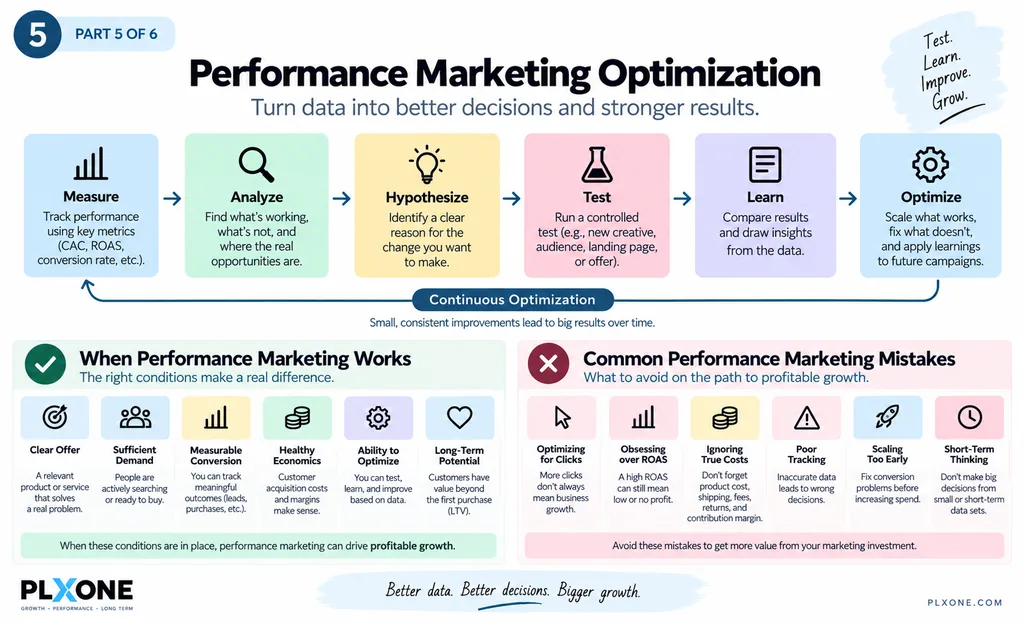
Once we have reliable performance data, the next question is simple: what should we change?
Optimization is where measurement turns into action.
A campaign may show that one audience is more expensive, one advertisement converts better, or a landing page is losing potential customers. The job is not to react to every movement in the numbers.
The job is to identify what deserves attention and make a deliberate change.
Start With the Problem
Suppose a campaign is getting plenty of clicks but very few purchases.
We could immediately change the advertisement.
But first, we need to understand what the data is actually pointing toward.
Is the audience relevant?
Is the offer strong enough?
Is the landing page doing its job?
Is something happening during checkout?
The goal is to move from “something isn’t working” to “we have a reasonable explanation for why it isn’t working.”
Make Changes for a Reason
Suppose one audience is generating customers at a significantly higher acquisition cost than another.
We might decide to reduce its budget.
But if we simultaneously change the audience, creative, landing page, offer, budget, and bidding, it becomes difficult to know what actually changed the result.
A better approach is to make a deliberate change based on what we have observed and then measure the impact.
Optimization should create better decisions, not simply more activity inside the advertising account.
Don’t Optimize the Dashboard Instead of the Business
This is one of the easiest mistakes to make.
Suppose CTR improves from 2% to 4%.
That sounds positive.
But if conversions fall and customer acquisition becomes more expensive, the campaign hasn’t necessarily improved.
The same applies to CPC.
A lower CPC isn’t automatically a good result if those cheaper clicks produce fewer valuable customers.
A marketing metric can improve while the business outcome gets worse.
So optimization should always connect back to the original business objective.
Optimization Is Continuous
Customer behaviour changes.
Competition changes.
Offers change.
Seasonality changes.
Advertising platforms change.
The business itself changes.
That means optimization isn’t a one-time activity.
We measure what happened, identify what deserves attention, investigate the likely cause, make a deliberate change, and measure again.
Measure → Identify → Investigate → Optimize → Measure again
The purpose isn’t to make every metric look better.
The purpose is to improve the outcome that matters to the business.
The PLXONE Approach to Optimization
For PLXONE, optimization isn’t about constantly changing campaigns.
It is about creating a disciplined process for making better marketing decisions.
Good optimization isn’t about changing more things. It is about making better changes for better reasons.
Benefits & Limitations of Performance Marketing
When your own money is going into marketing, you naturally look at the results differently. It isn’t enough to know that an advertisement received clicks or that a campaign generated sales. You want to know what that money actually produced for the business.
That is where performance marketing can be valuable.
What Performance Marketing Does Well
The biggest advantage is measurability.
When tracking is set up properly, we can see what is happening at different stages of the customer journey:
- How many people saw the campaign
- How many clicked
- How many converted
- What it cost to generate those conversions
- How much attributed revenue was generated
- Which campaigns or audiences performed better
That gives the business something much more useful than guesswork: a feedback loop.
We can measure what happened, identify what needs attention, make a change, and see what happens next.
Performance marketing can also give businesses greater control over advertising investment. Budgets can be tested, campaigns compared, and spending adjusted based on the results.
But that doesn’t mean performance marketing can solve every growth problem.
What Performance Marketing Cannot Fix
A campaign can be measured and optimized, but the advertising itself cannot automatically fix problems elsewhere in the business.
For example:
- The product may not have enough demand.
- The offer may not be competitive.
- Margins may be too low.
- The checkout experience may be creating friction.
- Customer retention may be weak.
Putting more money into advertising doesn’t automatically fix these problems.
Sometimes it simply brings more potential customers into the same problem.
More Traffic Is Not Always the Answer
Suppose an ecommerce business is already getting 1,000 visitors from paid advertising, but very few are purchasing.
The easy reaction is:
“We need more traffic.“
But I would ask:
“Why aren’t the people already visiting the website buying?“
The answer could be the product, offer, price, product page, checkout, or something else in the customer journey.
Until we understand that, buying more traffic is only a guess.
Where Performance Marketing Fits
I don’t see performance marketing as a magic growth engine.
I see it as a measurable system for acquiring customers, evaluating marketing activity, and improving marketing decisions.
It can be powerful when the business has something worth taking to market and the economics support customer acquisition.
But when there is a fundamental problem in the business, putting more money into advertising may simply amplify the problem instead of solving it.
That is an important limitation to understand before increasing performance marketing spend.
When Performance Marketing Works — and When It Doesn’t
The difficult decision is often not whether to run performance marketing, but whether to put more money behind it.
Before increasing the budget, I would look at what the current campaign is telling us.
Is it consistently acquiring the right customers?
Is the acquisition cost within a range the business can support?
Are customers actually converting?
Is the offer working?
And are the results holding up as we increase spend?
These questions help us decide whether the campaign is ready for more investment—or whether something needs attention first.
When Should We Consider Scaling?
Suppose a campaign is consistently generating customers at an acquisition cost the business can support.
The conversion rate is reasonably stable.
The measurement is reliable.
The customers being acquired have enough value to justify the investment.
And the business can handle additional demand.
In that situation, increasing the budget may be worth testing.
But scaling should still be a measured decision, not an automatic next step.
A campaign that works at ₹50,000 in monthly spend may not behave exactly the same way at ₹5 lakh.
When Should We Investigate First?
Now consider a different situation.
The campaign is generating traffic, but conversions are falling.
Or customer acquisition cost is increasing.
Or the campaign is generating customers, but those customers have low value.
The immediate reaction might be:
“Let’s increase the budget and see if we can get more sales.”
I wouldn’t make that decision yet.
I would first want to understand why the performance is changing.
Until we understand the reason, increasing spend is a reaction—not a strategy.
When More Advertising May Make the Problem Worse
There are situations where the problem isn’t primarily the campaign.
A business may be receiving traffic but have poor conversion, low margins, high returns, or weak retention.
In that situation, increasing advertising spend can simply bring more potential customers into the same problem.
The better decision may be to address the underlying issue first and then reassess the marketing investment.
Scaling Is Not the Same as Spending More
Spending more simply means increasing the advertising budget.
Scaling means increasing investment while maintaining acceptable performance and business economics.
That’s why we need to watch what happens as spend increases.
If acquisition costs rise sharply, conversion rates fall, or customer quality deteriorates, simply adding more budget may no longer be efficient.
The Decision We Should Make
For me, the question isn’t: “Can we spend more?“
It is: “Does putting more money into this marketing activity have a reasonable chance of creating additional business value?“
If the answer is supported by the data and business economics, scaling can be tested.
If the answer isn’t clear, investigate first.
That is the difference between reacting to campaign numbers and making a performance marketing decision.
Common Performance Marketing Mistakes
The expensive mistakes in performance marketing are not always caused by a wrong campaign setting. Sometimes the bigger mistake is making a marketing decision before understanding the business problem behind it.
I know this from experience. When I first started running Google Ads myself, I was focused on getting the campaigns running and generating results. Without enough understanding of how the platform, measurement, and business economics worked together, I ended up losing money.
That experience changed the way I look at performance marketing.
1. Starting With the Advertising Platform
A business decides:
“Let’s run Google Ads.“
But that is not a strategy.
The platform should help execute the strategy—not create it.
2. Optimizing for the Wrong Metric
A campaign gets lots of clicks, so it looks successful.
But clicks don’t pay the bills.
A campaign can also have a strong CTR or ROAS while failing to produce the business outcome we actually need.
The question should be:
“Which metric represents the outcome we’re trying to improve?“
3. Scaling Before Understanding the Economics
Seeing sales from a campaign can create the temptation to increase the budget immediately.
But sales alone don’t tell us whether additional spending will create additional business value.
Before scaling, we should understand the acquisition economics and whether performance is likely to remain acceptable as spend increases.
4. Changing Too Many Variables at Once
If we change the audience, creative, offer, landing page, budget, and bidding at the same time, it becomes difficult to know what actually improved the campaign.
Changes should have a clear reason behind them so the result can be evaluated properly.
5. Treating Platform Numbers as the Complete Truth
Google Ads, Meta Ads, and other platforms provide valuable data.
But platform-reported performance is not automatically the same as actual business performance.
We still need to connect marketing data with:
- Actual orders
- Revenue
- Costs
- Refunds
- Customer value
- Margins
6. Ignoring Customer Quality
Getting more customers isn’t automatically better.
Two campaigns can acquire customers at similar costs while producing very different customer value.
That’s why CAC should be considered alongside customer value and the wider economics of the business.
7. Assuming Attribution Equals Causation
If an advertising platform attributes a conversion to a campaign, it doesn’t necessarily mean that campaign caused the entire purchase.
Customers can interact with several channels before buying.
Attribution deserves interpretation, not blind acceptance.
The Bigger Mistake
Most of these mistakes come back to one underlying problem:
Treating performance marketing as a collection of advertising settings instead of a business decision-making process.
The advertising platform is only one part of the system.
The goal isn’t to avoid every mistake. The goal is to make marketing decisions based on a clear business objective, reliable measurement, and an understanding of what the numbers actually mean.
Performance Marketing Examples
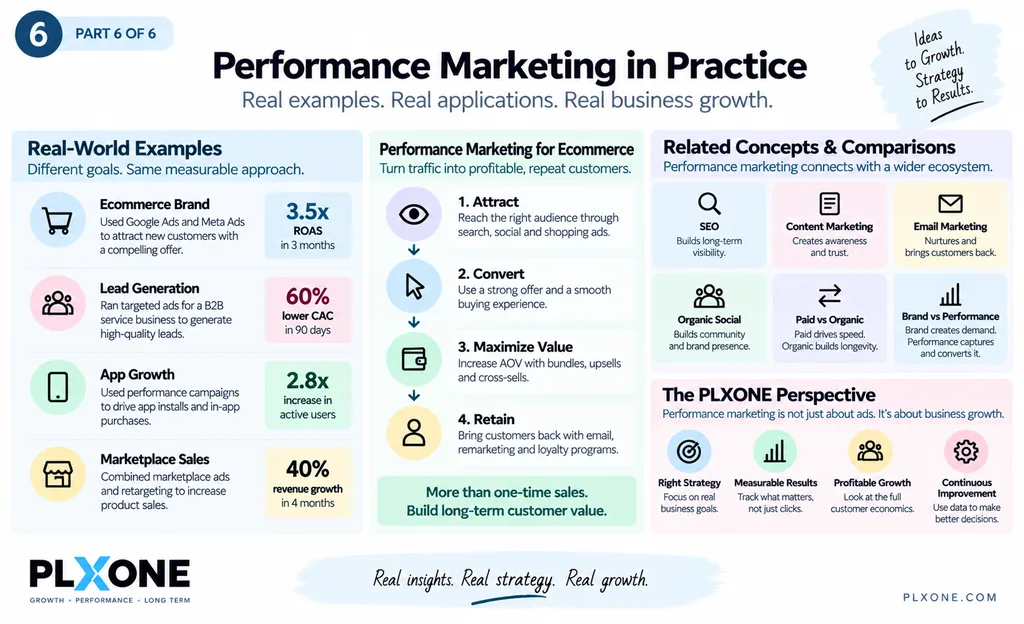
Numbers become much more useful when we put them into a real business situation.
Example 1: More Customers Doesn’t Always Mean Better Performance
Suppose two campaigns produce:
Campaign A
- Spend: ₹50,000
- New customers: 100
- CAC: ₹500
Campaign B
- Spend: ₹75,000
- New customers: 150
- CAC: ₹500
Campaign B generated more customers, but both campaigns acquired customers at the same CAC.
Now suppose Campaign B’s customers are more likely to purchase again.
The decision becomes different.
Customer volume alone doesn’t tell us which campaign creates more value.
Example 2: A Good ROAS Doesn’t Automatically Mean Profit
Suppose a campaign spends ₹50,000 and generates ₹2,00,000 in attributed sales.
The ROAS is 4.
That sounds good.
But ₹2,00,000 is revenue—not profit.
The business may still have product costs, fulfilment costs, discounts, payment fees, returns, and other expenses.
So the better question is:
“After considering the relevant business costs, does acquiring these customers make economic sense?”
Example 3: Lots of Traffic, Few Purchases
Imagine a campaign generates 10,000 clicks, but very few people purchase.
It would be easy to say:
“The advertising isn’t working.”
But what happens after the click?
Is the traffic relevant?
Is the offer attractive?
Is the product page convincing?
Is the checkout creating friction?
The problem may be the advertisement—but it may also be somewhere further along the customer journey.
The numbers should help us find the problem, not simply label the campaign.
Example 4: When Should We Increase the Budget?
Suppose a campaign is generating customers at a CAC the business can sustainably support, with reasonably stable conversion and reliable measurement.
Increasing the budget may be worth testing.
But if CAC is already too high, increasing spend simply because the campaign is generating sales may not make sense.
The difference is:
“The campaign is generating sales, so let’s spend more.”
versus:
“The campaign is generating customers at economics that make sense, so let’s test whether we can scale it.”
What These Examples Show
Performance marketing isn’t about finding one impressive number.
It is about connecting:
Spend → Conversion → Customer → Revenue → Customer Value → Business Economics
The better question isn’t simply:
“Did the campaign get results?”
It is: “What did it produce, what did it cost, what value did it create, and should we do more of it?”
This is where performance marketing becomes a decision-making discipline rather than a dashboard exercise.
Performance Marketing for Ecommerce
Running an ecommerce business taught me that an order is not the end of the marketing story. What happens after that order can be just as important to the health of the business.
A customer may see an advertisement, visit a product page, place an order, receive the product, and then either purchase again or never return.
So for ecommerce, I prefer to look at the complete journey:
Ad → Product Page → Cart → Checkout → Purchase → Repeat Purchase
Every stage can influence whether the original marketing investment was worthwhile.
Start With the Product, Not the Advertisement
Before thinking about scaling an ecommerce campaign, I would want to understand the product and the offer.
Is there genuine demand?
Who is most likely to buy it?
What makes the product valuable?
Is the price appropriate for the market?
Does the business have enough margin to acquire the customer?
Advertising can bring people to a product, but it cannot fix every problem with the product or offer.
The Click Is Only the Beginning
Suppose someone clicks a Google Ad and reaches a product page.
The campaign has done its job of bringing a potential customer to the website.
But the rest of the journey still has to work.
Does the product page explain the value clearly?
Does the customer have enough information to make a decision?
Is the price creating resistance?
Is the checkout process simple?
Can the business fulfil the order properly?
If customers are clicking but not purchasing, I wouldn’t automatically blame the advertisement. I would follow the customer journey and find where the problem is occurring.
Revenue Doesn’t Tell the Whole Story
Two campaigns can generate similar revenue and still produce very different business results.
One may acquire customers at a higher CAC.
Another may attract customers who purchase again.
That’s why ecommerce performance may need to be evaluated using metrics such as:
- CAC
- AOV
- ROAS
- Gross Margin
- Contribution Margin
- Repeat Purchase Rate
- LTV
The purpose isn’t to track every number available.
It is to understand how marketing performance connects with the economics of the business.
New Customers and Existing Customers Are Different
Suppose an existing customer purchases again after receiving a remarketing message.
That sale is valuable.
But it is different from acquiring someone who has never purchased from the business.
So when evaluating performance, I would want to know:
Are we acquiring new customers, generating additional purchases from existing customers, or doing both?
That distinction prevents us from treating every sale as evidence of new customer growth.
What Happens After the First Purchase?
Customer acquisition is only one part of ecommerce growth.
If customers return and purchase again, the economics of the original acquisition can look very different.
A customer who costs ₹500 to acquire but purchases several times can create considerably more value than one who makes a single low-margin purchase.
This is why LTV, repeat purchase rate, and retention can become important when evaluating ecommerce performance.
The Bigger Picture
For ecommerce, we shouldn’t separate the advertising dashboard from the actual business.
We need to connect:
Marketing → Customer Acquisition → Purchase → Fulfilment → Retention → Customer Value → Business Economics
Instead of asking:
“How many sales did the campaign generate?“
we can ask:
“What kind of customers did we acquire, what did they cost, what value did they create, and what happened after the first purchase?“
That is where performance marketing becomes much more than advertising.
Related Concepts: Where Performance Marketing Fits
Marketing becomes easier to understand when we stop treating every marketing term as if it means the same thing.
Performance Marketing vs Paid Advertising
Paid advertising means paying a platform or publisher to reach an audience.
Performance marketing is broader. It focuses on measurable outcomes, evaluation, and optimization.
So: Paid advertising can be part of performance marketing, but the two aren’t the same thing.
Performance Marketing vs Customer Acquisition
Customer acquisition is about attracting and converting new customers.
Performance marketing can support that objective through channels such as Google Ads, Meta Ads, SEO, referrals, marketplaces, or other measurable activities.
So customer acquisition is the outcome, while performance marketing is an approach that can help achieve and measure that outcome.
Performance Marketing vs Digital Marketing
Digital marketing is the broader field.
It can include:
- SEO
- Content marketing
- Social media
- Email marketing
- Online advertising
- Marketplaces
Performance marketing places greater emphasis on measurable outcomes and optimization.
A business can therefore have a digital marketing strategy without every activity being performance marketing.
Performance Marketing vs Growth Marketing
These terms overlap, but they aren’t identical.
Performance marketing asks:
What did our marketing activity produce, what did it cost, and what should we improve?
Growth marketing asks:
Where can we experiment across the customer journey to improve growth?
Growth marketing can extend into activation, retention, referral, and experimentation.
Performance marketing can contribute to growth, but the two shouldn’t automatically be treated as synonyms.
A Simple Way to Remember the Difference
Digital marketing
How are we reaching and communicating with customers digitally?
Paid advertising
Are we paying to reach an audience?
Customer acquisition
Are we turning prospects into new customers?
Performance marketing
What did the marketing activity produce, what did it cost, and what should we improve?
Growth marketing
What can we test across the customer journey to improve growth?
These concepts overlap, but they aren’t interchangeable.
And this is why I wouldn’t start by asking:
“Which advertising platform should we use?”
I would start with:
“Who are we trying to reach, what are we trying to achieve, and how will we know whether the investment is working?“
Once those answers are clear, the role of the channel becomes much easier to understand.
Performance marketing is ultimately about connecting marketing activity with measurable business outcomes—not simply choosing an advertising platform.
The PLXONE Perspective on Performance Marketing
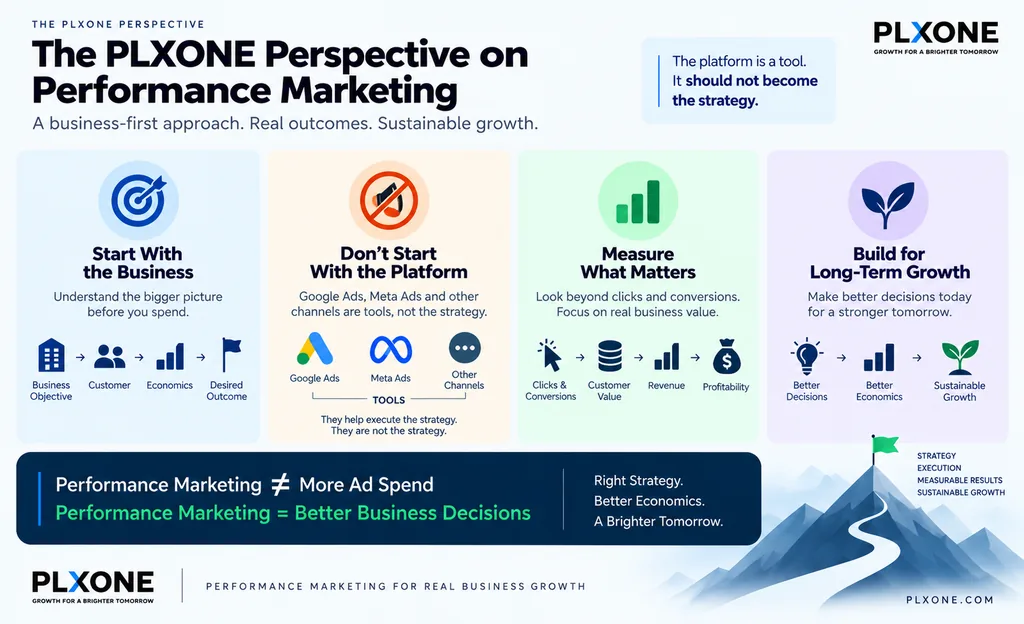
I don’t believe performance marketing should begin with the question, “How much should we spend?”
My own experience of building a business changed the way I look at marketing investment. When you have built something with your own money and effort, every marketing rupee has to have a reason behind it.
A campaign can generate clicks.
It can generate conversions.
It can generate revenue.
But those numbers alone don’t tell us whether the marketing investment is creating meaningful value for the business.
Start With the Business, Not the Platform
Before deciding whether to use Google Ads, Meta Ads, or another channel, I believe we should first understand:
- What are we trying to achieve?
- Who are we trying to reach?
- What are we offering?
- What does it reasonably cost to acquire a customer?
- How will we measure the result?
- Does the customer create enough value for the business?
Once we understand the objective and the customer, we can decide where to reach them.
The platform is a tool.
It should not become the strategy.
Marketing Numbers Need Business Context
A performance marketing dashboard can tell us a lot.
But the dashboard doesn’t run the business.
A good CTR doesn’t guarantee sales.
A good conversion rate doesn’t guarantee profitability.
A strong ROAS doesn’t automatically mean the business is making enough money.
A low CAC doesn’t automatically mean the customers are valuable.
These numbers become meaningful when we connect them with revenue, costs, margins, customer value, retention, and the actual objective of the business.
That is why I don’t believe performance marketing should be evaluated separately from the business.
Don’t Scale What You Can’t Explain
When a campaign is performing well, increasing the budget can be tempting.
But before doing that, I would want to understand why it is working and whether the economics can support additional investment.
If the results are strong, measurement is reliable, and the business can support more customers, scaling may be worth testing.
If something isn’t working, increasing the budget may simply increase the amount of money being spent without solving the underlying problem.
The process is simple:
Measure → Identify → Investigate → Optimize → Measure again
The purpose isn’t to make every campaign metric look better.
The purpose is to make better marketing decisions.
What Performance Marketing Should Ultimately Do
For me, performance marketing is about using marketing investment more intelligently.
It should help a business:
- Understand its customers
- Choose appropriate channels
- Measure meaningful outcomes
- Understand acquisition economics
- Identify what is working
- Identify what needs attention
- Test improvements
- Scale what creates value
It should not be treated as a magic solution for every business problem.
It cannot make a poor product desirable.
It cannot automatically fix weak margins.
It cannot guarantee profitable growth.
And it cannot replace good business decisions.
Performance marketing should help us understand where marketing investment is creating value, where it is being wasted, and what should happen next.
That is the perspective we bring to performance marketing at PLXONE.
We don’t start with the advertising platform. We start with the business objective, the customer, the economics, and the outcome we are trying to create.
FAQ
1. What is performance marketing?
Performance marketing is an outcome-focused approach to marketing where businesses measure marketing activity, evaluate the results, and use the data to improve future decisions. It can involve channels such as Google Ads, Meta Ads, affiliate marketing, and other measurable digital channels.
2. What is the difference between performance marketing and digital marketing?
Digital marketing is the broader field of marketing through digital channels. Performance marketing focuses more specifically on measurable outcomes, measurement, and optimization. Performance marketing can therefore be part of a broader digital marketing strategy.
3. Is performance marketing the same as paid advertising?
No. Paid advertising means paying a platform or publisher to reach an audience. Performance marketing is an outcome-focused approach that measures and evaluates marketing results. Paid advertising can be one component of performance marketing.
4. Which channels are used in performance marketing?
Common channels include Google Ads, Meta Ads, display advertising, retargeting, affiliate marketing, and other measurable digital acquisition channels. The appropriate channel depends on the customer, business objective, buying journey, and economics.
5. What are the most important performance marketing metrics?
There is no single metric that works for every business. Depending on the objective, important metrics may include conversion rate, CPA, CAC, ROAS, revenue, AOV, LTV, margins, and repeat purchase rate.
The important question is not how many metrics you can track, but which metrics help you understand the business outcome.
6. What is CAC in performance marketing?
Customer Acquisition Cost (CAC) is the average cost of acquiring a new customer. It should be evaluated alongside customer value, margins, and other business economics rather than viewed in isolation.
7. Is a high ROAS always good?
No. ROAS measures attributed revenue in relation to advertising spend; it does not represent profit. A campaign can have a strong ROAS while still producing weak business economics after product costs, fulfilment, discounts, fees, and other relevant costs are considered.
8. Does a business owner need to learn Google Ads before hiring a performance marketing professional?
No. A business owner does not need to become a Google Ads expert. However, understanding the business objective, important marketing metrics, customer acquisition economics, and the questions to ask can help the owner make better decisions and evaluate marketing investment more effectively.
The technical execution can be handled by a qualified performance marketing professional.
9. When should a business increase its performance marketing budget?
A business should not increase its budget simply because a campaign is generating sales. Before scaling, it is useful to understand whether the current performance and acquisition economics can support additional investment.
If those numbers remain healthy as spend increases, scaling can be tested carefully.
10. Can performance marketing guarantee profitable growth?
No. Performance marketing can help businesses measure, test, optimize, and scale marketing activity, but it cannot guarantee profitability. Product demand, offer quality, customer experience, margins, retention, and other business factors also affect the final outcome.
Pingback: Google Ads Cost: What Businesses Need to Know | PLXONE
Pingback: Customer Acquisition Cost (CAC): How to Calculate It|PLXONE
Pingback: ROAS vs Profitability: Does High ROAS Mean More Profit?
Pingback: Marketing Attribution: How to Measure What Drives Sales