
For a long time, I looked at marketing numbers the way many business owners do.
How many clicks did we get?
How many leads came in?
How much revenue did the campaign generate?
But there was another question I wasn’t asking clearly enough:
How much did it actually cost us to acquire a customer?
I learned the importance of this question the hard way.
At one point, we were spending around ₹2.5 lakh a month on Google Ads. The campaigns were generating clicks and conversions, so on the surface there was activity. But when I looked at the numbers more closely, we were getting only around 10–15 conversions a month, while revenue was approximately ₹15,000–₹20,000 a month.
The calculation was uncomfortable.
₹2.5 lakh of advertising spend divided by 10–15 conversions meant approximately ₹16,667–₹25,000 per conversion.
That experience changed how I look at acquisition.
The important question is not whether a campaign is generating clicks, leads, or even conversions. The real question is whether the cost of acquiring customers makes business sense.
That is where Customer Acquisition Cost (CAC) becomes important.
In this article, I’ll break down how CAC is calculated, what should—and should not—be included in the calculation, why CAC can sometimes give you the wrong picture, and how to connect it with customer value and profitability.
Because ultimately, growth is not about acquiring more customers at any cost. It’s about acquiring customers in a way that makes the business stronger.
What Is Customer Acquisition Cost (CAC)?
Think about the last time you looked at your marketing report.
You probably saw numbers like clicks, leads, conversions, ad spend, and revenue.
But there is one question that brings those numbers together:
How much did we spend to get each new customer?
That is what Customer Acquisition Cost (CAC) helps you understand.
A click tells you someone showed interest.
A lead tells you someone raised their hand.
A conversion tells you that a defined action happened.
A customer is someone who actually completes the transaction or takes the defined action that makes them a customer of your business.
CAC shifts your attention from individual marketing activities to the cost of acquiring the customer behind those activities.
And that changes the conversation.
Instead of asking:
“How many leads did we generate?”
you can ask:
“What did it cost us to turn our acquisition efforts into actual customers?”
That number becomes much more useful when you compare it with what those customers are worth to your business.
A ₹500 CAC might look expensive for one business and perfectly reasonable for another.
So there is no universal CAC number that every business should aim for.
Your CAC only starts to make sense when you look at it in the context of your business, your customer value, and your profitability.
That’s the part we need to understand before simply trying to make CAC “lower.”
How to Calculate Customer Acquisition Cost
You don’t need a complicated spreadsheet to start.
Take the numbers from a specific period—say, one month—and ask yourself two questions:
How much did we spend to acquire customers?
How many new customers did we acquire?
Now divide the first number by the second:
CAC = Total Acquisition Cost ÷ New Customers Acquired
For example:
Total acquisition cost: ₹1,00,000
New customers: 100
₹1,00,000 ÷ 100 = ₹1,000 CAC
Now change just one number.
If the same ₹1,00,000 brought in 50 new customers:
₹1,00,000 ÷ 50 = ₹2,000 CAC
Your spending didn’t change.
Your CAC doubled because you acquired half as many customers.
This is why looking at CAC over time can tell you more than looking at the number in isolation.
But before you calculate yours, stop for a moment and check the two numbers you’re putting into the formula.
Are you counting all the acquisition costs that belong in your calculation?
And are you counting actual new customers, rather than leads, enquiries, or other conversions?
If those inputs aren’t consistent, your CAC can give you a very confident-looking number that doesn’t actually describe your business.
The formula is simple. Your definitions determine whether the answer is useful.
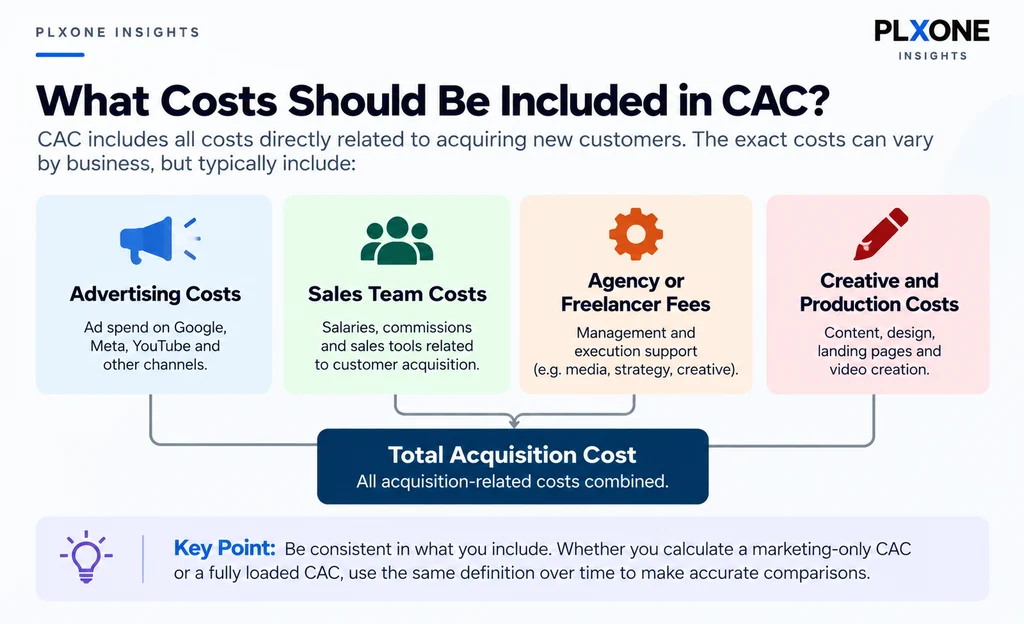
What Costs Should Be Included in CAC?
This is where CAC can get tricky.
Let’s say you spent ₹1,00,000 on Meta Ads and acquired 100 customers.
It is tempting to say:
₹1,00,000 ÷ 100 = ₹1,000 CAC
But ask yourself one more question:
Was Meta Ads the only thing you spent money on to acquire those customers?
Maybe you also paid for:
- Sales team or sales commissions
- Agency or freelancer fees
- Ad creatives
- Landing pages or other acquisition-related work
If those costs were directly involved in acquiring those customers, ignoring them can make your CAC look better than it really is.
For example, if your actual acquisition-related spend was ₹1,20,000, and you acquired the same 100 customers:
₹1,20,000 ÷ 100 = ₹1,200 CAC
That’s a very different number from ₹1,000.
This doesn’t mean every business must include exactly the same costs.
The important thing is to decide what belongs in your acquisition calculation and use the same approach consistently.
Otherwise, you may compare two CAC numbers that were calculated differently and think your acquisition became more efficient when the calculation itself simply changed.
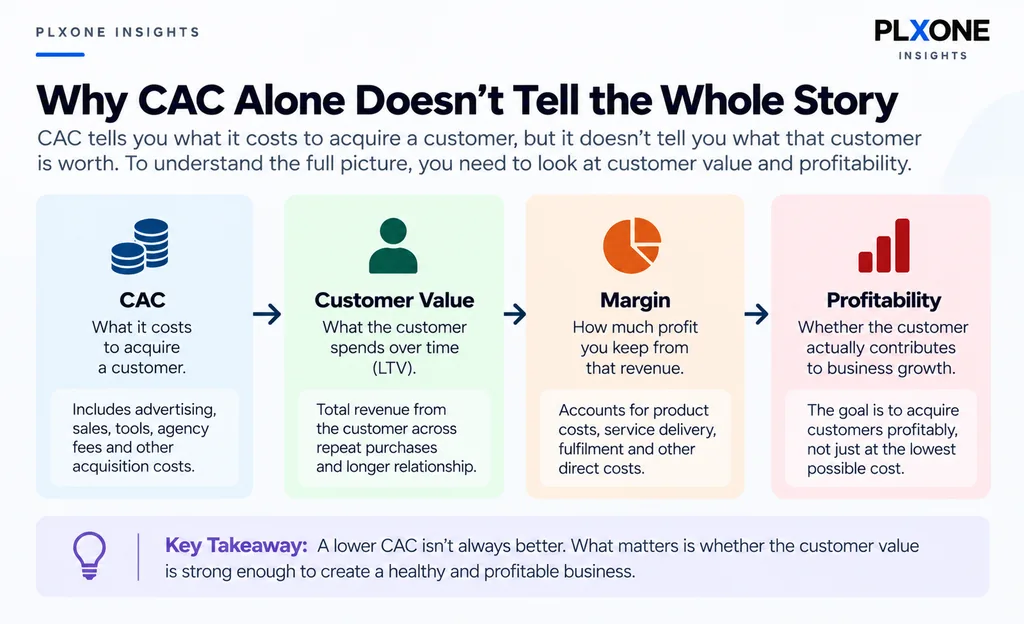
Why CAC Alone Doesn’t Tell the Whole Story
Now imagine you calculate your CAC and get this:
CAC = ₹1,000
Is that good?
Don’t answer yet.
Ask one more question:
What does the customer you acquired for ₹1,000 actually bring to the business?
Suppose Customer A costs you ₹1,000 to acquire and makes one ₹1,200 purchase.
Customer B also costs ₹1,000 to acquire—but comes back several times and spends much more over time.
Same CAC.
Very different business outcomes.
Now look at it from another angle.
Your CAC could go from ₹1,500 to ₹1,000.
At first glance, that looks like an improvement.
But what if the customers you acquired at ₹1,000 are buying less, returning more products, or not coming back?
You reduced CAC.
But did you improve the business?
This is why I don’t like treating CAC as a target that should simply keep going down.
CAC tells you what it costs to acquire the customer.
It does not, by itself, tell you:
- how much profit that customer generates,
- how long they stay with your business,
- whether they buy again,
- or whether the acquisition is sustainable.
So when you see a CAC number, don’t stop at:
“Is this CAC low?”
Ask:
“What are we getting for this CAC?”
That question takes us from acquisition cost to the value of the customer we’re acquiring.
When Should You Look at CAC?
Don’t wait until the end of the year to calculate CAC.
If you’re spending money to acquire customers, CAC should be something you check regularly.
But don’t make the mistake of looking at it every day and reacting to every movement.
Imagine your numbers look like this:
Month 1 → CAC: ₹1,200
Month 2 → CAC: ₹1,050
Month 3 → CAC: ₹1,300
Month 3 is higher.
Should you immediately cut your marketing?
Not necessarily.
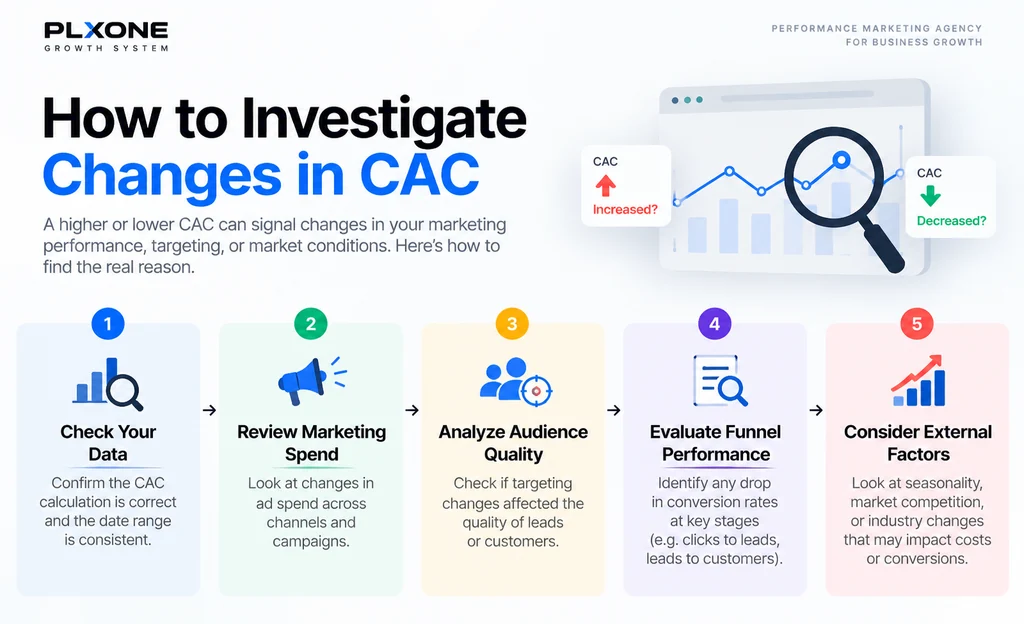
Before changing anything, go one level deeper.
Ask:
What changed?
Maybe you changed your audience.
Maybe the offer changed.
Maybe competition increased.
Maybe one acquisition channel performed differently.
Maybe you acquired fewer customers during the month.
Now the CAC number becomes useful.
Instead of simply saying:
“CAC increased.”
you can ask:
“Why did it increase?”
That’s a much better business question.
I would also avoid looking at CAC only at the overall business level. Break it down when the data allows it—by channel, campaign, customer segment, or time period.
You may find that one channel has a higher CAC but brings customers who stay longer or spend more.
That is why I see CAC as a diagnostic number, not a number to chase.
Don’t just track CAC. Investigate what is moving it.
What Is a Good Customer Acquisition Cost?
So you have calculated your CAC.
Now comes the question most founders ask:
“Is this a good CAC?”
There isn’t a number I can give you that will answer that.
Because CAC only becomes meaningful when you put it next to your own business numbers.
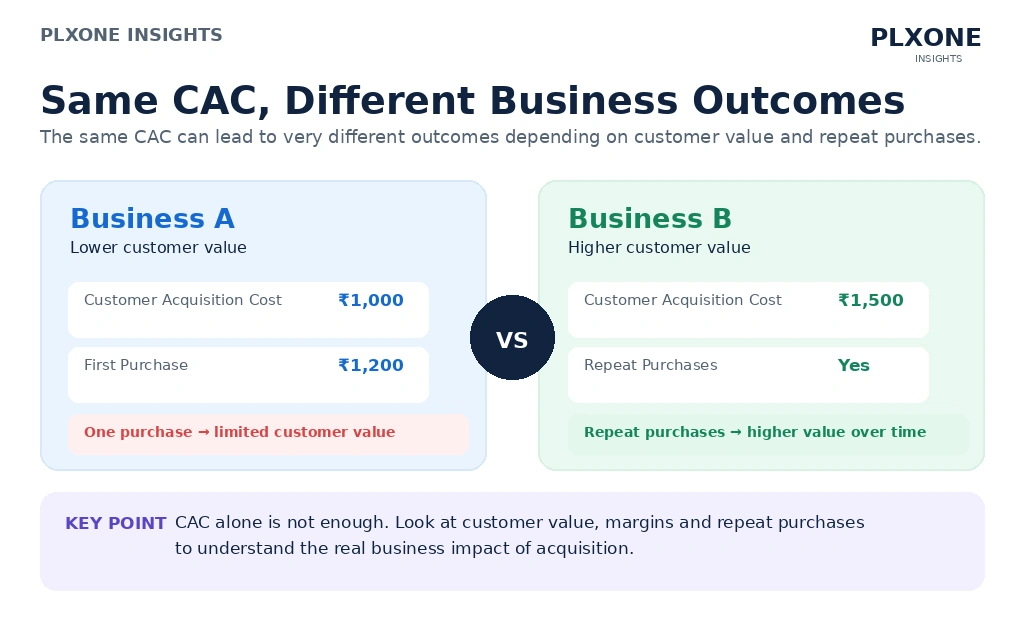
Let’s say your CAC is ₹1,000.
Is that good?
Before answering, I would look at what happens after the customer is acquired.
If the customer buys once for ₹1,200, the situation is very different from a customer who buys for ₹1,200 today and comes back several times.
And revenue alone isn’t enough either.
You still have the cost of the product, delivery, payment processing, discounts, returns, and other costs to consider.
So instead of asking:
“Is ₹1,000 a good CAC?”
ask:
“Can my business acquire customers at ₹1,000 and still make enough money to grow?”
That is a much more useful question.
It also means you shouldn’t blindly chase a lower CAC.
Reducing CAC from ₹1,000 to ₹700 sounds great.
But if the customers acquired at ₹700 buy less, return more, or don’t come back, the lower CAC may not actually improve the business.
A good CAC is not the lowest CAC.
It is a CAC that works with your customer value, margins, and overall business economics.
And that brings us to the next question:
How much is a customer actually worth after the first purchase?
CAC vs Customer Lifetime Value (LTV)
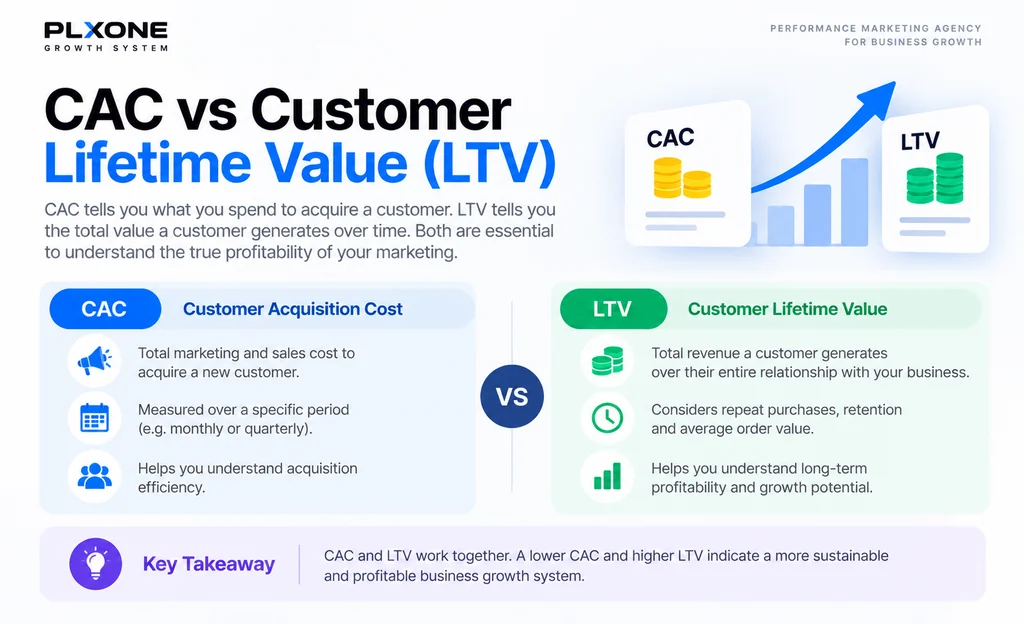
CAC tells you what it costs to acquire a customer.
LTV tells you what that customer can be worth to the business over time.
Looking at only one of them can give you an incomplete picture.
I learned this the hard way when looking at our own advertising.
We were spending around ₹2.5 lakh a month on Google Ads, but the revenue generated was only around ₹15,000–₹20,000 a month.
Looking at acquisition cost alone was already a warning sign.
But the bigger lesson was this:
You cannot judge customer acquisition properly without understanding the value of the customers you are acquiring.
Imagine two businesses:
Business A
CAC = ₹1,000
Customer buys once.
Business B
CAC = ₹1,500
Customer buys repeatedly over time.
Looking only at CAC, Business A appears cheaper.
But if Business B generates much more value from each customer, the higher CAC may still make economic sense.
This is why CAC and LTV should be looked at together.
A simple way to think about it is:
CAC = What you spend to acquire the customer
LTV = What that customer is worth over their relationship with your business
The exact LTV calculation depends on the business model, purchase frequency, margins, retention, and customer lifespan.
So don’t ask only:
“How cheaply can I acquire a customer?”
Ask:
“What is this customer worth to my business, and does the cost of acquiring them make sense against that value?”
That shift—from acquisition cost to customer economics—is where CAC becomes a much more useful growth metric.
How to Reduce CAC Without Sacrificing Growth
When you see a high CAC, the obvious reaction is:
“We need to bring this number down.”
But I would pause before changing the campaign.
I have made the mistake of looking at advertising as something that simply needs more optimization without first asking whether the underlying setup was right.
In our case, we were spending around ₹2.5 lakh a month on Google Ads, getting roughly 10–15 conversions a month, and generating approximately ₹15,000–₹20,000 in revenue.
The problem wasn’t simply that the clicks were expensive.
The bigger problem was that the acquisition strategy itself wasn’t working.
That changed how I think about reducing CAC.
If CAC is high, don’t start by asking:
“How can I get cheaper clicks?”
Start with:
“Where are we losing money between spending and acquiring the customer?”
It could be the targeting.
It could be the offer.
It could be the conversion experience.
It could be the quality of traffic.
Or it could be that the campaign is reaching people who were never likely to become valuable customers in the first place.
Only after finding the actual problem does optimization make sense.
For example, reducing CPC from ₹100 to ₹60 sounds like a win.
But if those cheaper clicks produce fewer customers, your CAC may actually increase.
So I would look at the complete path:
Spend → Traffic → Conversion → Customer → Customer Value
The objective isn’t to make any one number look better.
The objective is to make the whole acquisition system work better.
That is how I would approach reducing CAC without sacrificing growth.
The PLXONE Perspective on Customer Acquisition Cost
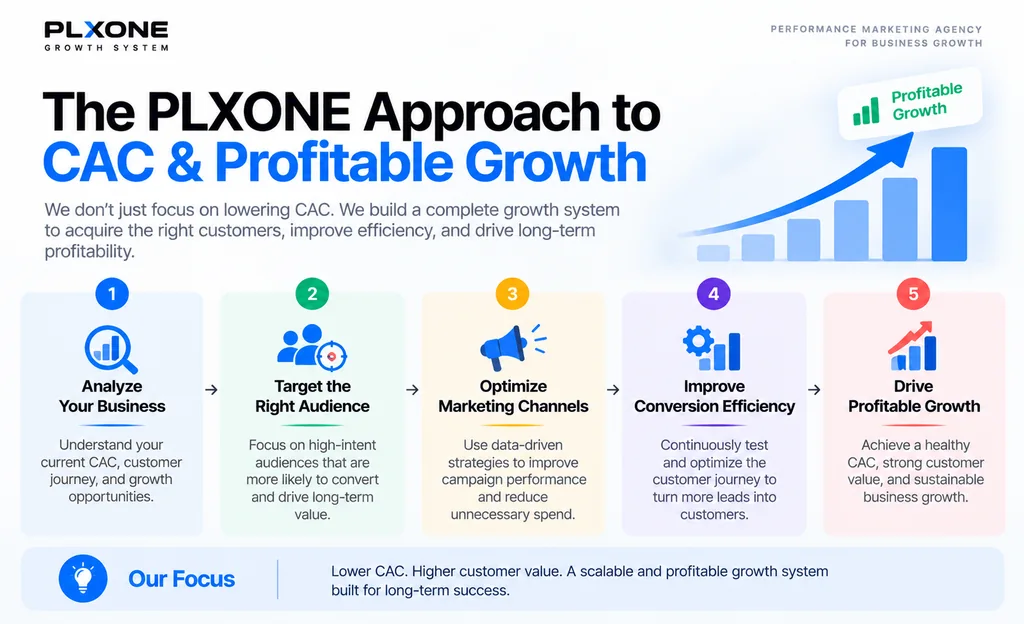
At PLXONE, we don’t look at CAC as a number that marketing has to make smaller.
We look at it as a business signal.
A rising CAC can tell us that something in the acquisition system needs to be investigated. A falling CAC can be encouraging—but it doesn’t automatically mean the business is becoming healthier.
That’s why we don’t want to optimize CAC in isolation.
We want to understand the complete picture:
How much are we spending?
Where are customers coming from?
What does it cost to acquire them?
What are those customers worth?
And what happens to profitability as we scale?
This is also why a channel-by-channel view is not enough.
Google Ads may be generating customers. Meta may be generating customers. Organic search may be generating customers. But the business doesn’t grow because individual channels look good on a dashboard.
The business grows when the acquisition system works together.
Our approach is therefore simple:
Measure → Identify → Investigate → Optimize → Measure again.
We don’t start by asking, “How do we get CAC down?”
We start by asking:
“What is CAC telling us about the way this business is acquiring customers?”
Because the goal isn’t cheaper customers at any cost. The goal is sustainable customer acquisition that supports profitable business growth.
FAQ
What is Customer Acquisition Cost (CAC)?
Customer Acquisition Cost (CAC) is the average cost a business incurs to acquire a new customer. It helps connect sales and marketing investment with actual customer acquisition.
How do you calculate CAC?
The basic formula is:
CAC = Total Acquisition Cost ÷ New Customers Acquired
The important part is using a consistent definition of acquisition cost and counting actual new customers.
What is a good CAC?
There is no universal “good CAC.” It depends on your customer value, margins, repeat purchases, and overall business economics. A CAC that works for one business may not work for another.
Is CAC the same as Cost Per Acquisition (CPA)?
Not always. CPA can measure the cost of generating a specific conversion or action, while CAC specifically focuses on the cost of acquiring an actual customer. They are only the same when the measured acquisition event represents a customer.
Should advertising spend be included in CAC?
Yes, advertising spend is normally part of customer acquisition cost. Depending on the business, other acquisition-related expenses such as sales costs, agency fees, or creative costs may also need to be included.
Why is CAC important for business growth?
CAC helps a business understand how much it is investing to acquire customers. When viewed alongside customer value and profitability, it can help identify whether customer acquisition is sustainable as the business grows.
Should I always try to reduce my CAC?
No. A lower CAC is not automatically better. Reducing CAC by acquiring lower-value customers can hurt the business. The goal is to find an acquisition cost that works with your customer value and business economics.
Pingback: Google Ads Cost: What Businesses Need to Know | PLXONE
Pingback: Performance Marketing Guide: Profitable Growth | PLXONE
Pingback: ROAS vs Profitability: Does High ROAS Mean More Profit?
Pingback: Customer Acquisition Strategy Using Meta Ads
Pingback: Marketing Attribution: How to Measure What Drives Sales