
When I look back at my experience with Google Ads, one thing stands out: spending money on advertising doesn’t guarantee business growth.
I spent approximately ₹2.5 lakh on Google Ads and generated around ₹95,000 in revenue. Eventually, I stopped the campaigns. Looking back, I believe the bidding strategy and targeting were wrong.
That experience taught me why looking at advertising results without understanding what’s happening behind them can lead to poor decisions.
Now consider a business running both Google Ads and Meta Ads. A customer discovers the product on Instagram, searches for the brand on Google a few days later, and then makes a purchase. Meta Ads may report a conversion, and Google Ads may report one too, depending on the customer’s interactions and each platform’s attribution settings.
If the business looks at each dashboard separately, how does it determine what actually contributed to the sale?
This is where marketing attribution becomes useful. It helps businesses examine the customer journey and understand how different marketing touchpoints receive credit for conversions.
But the goal isn’t simply to decide which platform deserves credit. It’s to use the available evidence to make better marketing decisions—while recognizing that attributed conversions don’t automatically prove that advertising caused a sale or made it profitable.
For a business investing in marketing, that distinction matters. Before deciding where to spend more, you need to understand what your numbers are telling you, what they leave unanswered, and how those insights connect to actual business growth.
What Is Marketing Attribution and Why Does It Matter?
Imagine you run an ecommerce business selling skincare products.
Someone sees your Instagram ad but doesn’t buy anything. A few days later, they search for your brand on Google, visit your website, and leave. Then they see your retargeting ad, click it, and finally place an order.
Now, here’s the question: which channel brought you that sale?
Was it Instagram, because that’s where the customer first discovered your brand? Was it Google, because the customer searched for you? Or was it the retargeting ad that appeared just before the purchase?
This is exactly the kind of question marketing attribution helps you investigate.
Depending on the attribution model and tracking setup, the sale might be credited to the last interaction, the first interaction, or several touchpoints along the way.
Why should you care?
Because the answer can influence where you spend your marketing budget.
For example, if you look only at the last interaction, you might conclude that retargeting is doing all the work. You could then put more money into retargeting and reduce the campaigns that introduce new customers to your brand.
But that might be the wrong decision. Without those earlier interactions, some customers might never have discovered your business in the first place.
At the same time, you shouldn’t automatically assume that every ad a customer sees contributes to a sale. A customer might already be interested in your product or discover your brand through another channel.
The point of marketing attribution isn’t to give every channel credit. It’s to understand what your data can tell you before making your next marketing decision.
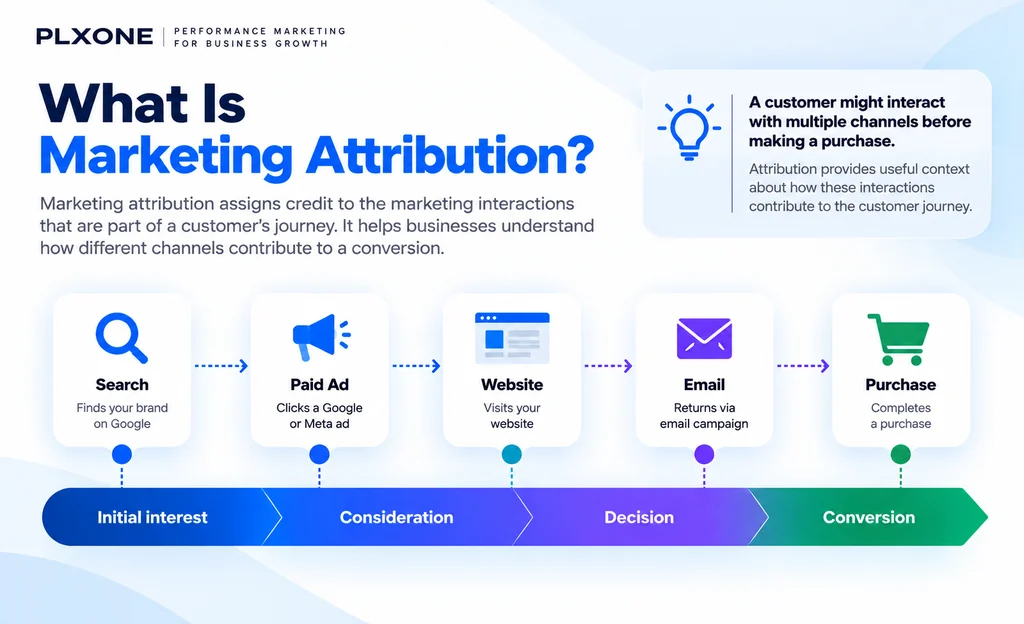
It won’t explain every reason a customer buys, but it can help you look beyond individual platform dashboards and make more informed decisions about your marketing investment.
Why It’s Difficult to Know What Drives Sales
Imagine you run an ecommerce business selling skincare products we discussed in the previous section.
On Monday, a customer sees your product in an Instagram ad. On Wednesday, they search for your brand on Google and visit your website. On Friday, they click another ad on Instagram and place an order worth ₹2,000.
One customer. One order. But several marketing touchpoints.
Now open your advertising dashboards. Meta Ads may report the purchase because the customer interacted with an Instagram ad. Google Ads may also report it if the customer clicked a Google ad and the purchase falls within its attribution settings.
Does that mean your business generated two orders?
No. Your store received one order worth ₹2,000. The platforms may both claim credit for that same purchase, depending on how their attribution systems are configured.
This is where things get confusing for business owners. If you add the conversions reported by different platforms without checking your actual orders, you could overestimate the sales generated by your marketing.
But there’s a second problem: knowing which channel gets credit doesn’t necessarily tell you which channel made the sale happen.
Think about the customer’s journey again. The first Instagram ad introduced the product. Google helped the customer find the brand again. The final Instagram ad brought the customer back to complete the purchase.
Which interaction mattered most?
The reports can show you how credit was assigned, but they cannot automatically tell you whether the customer would have purchased without that final ad—or whether the earlier interactions were more influential.
Tracking adds another layer of difficulty. A customer might see an ad on their phone, research the product on a laptop, and complete the purchase later. Depending on the tracking setup and available data, those interactions may not all be connected to the same customer journey.
So, how should you evaluate the results?
Start with the actual orders recorded by your store. Then compare them with Meta Ads, Google Ads, and analytics reports to understand what each platform is claiming credit for. Check the attribution settings and reporting periods before comparing the numbers.
Don’t expect every report to match. Instead, look for what the combined evidence tells you—and be careful not to treat attributed conversions as proof that a particular channel caused every sale.
Marketing attribution becomes more useful when you understand both its value and its limitations. It helps you make better-informed marketing decisions, but the numbers still need context.
How Do Marketing Attribution Models Work?
But how do you decide which marketing interaction gets credit for a sale when a customer has interacted with several channels?
The answer depends partly on the attribution model your business uses.
An attribution model is simply a rule for assigning credit to the marketing interactions that happen before a customer makes a purchase. Different models can look at the same customer journey and assign credit differently.
Let’s return to our skincare business. A customer discovers the brand through an Instagram ad, searches for the brand on Google a few days later, and eventually purchases after clicking another Instagram ad.
The customer has placed one order. But which interaction gets credit for it?
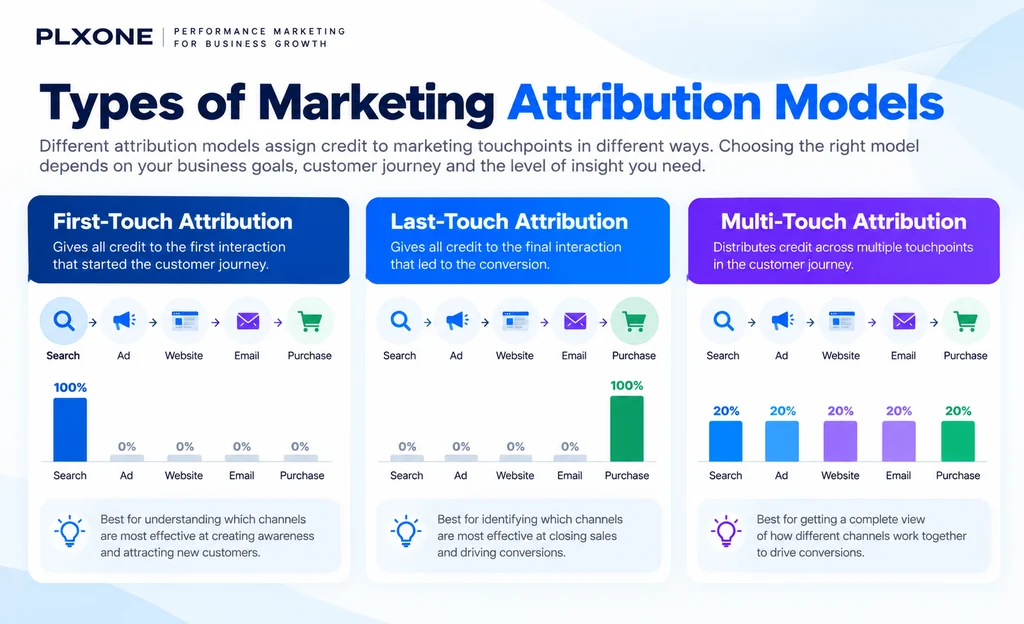
First-touch attribution gives all the credit to the first recorded interaction. In this example, the original Instagram ad gets the credit because it introduced the customer to the brand.
This can help you understand where customers first discover your business. However, it doesn’t tell you how much the later interactions contributed to the purchase.
Last-touch attribution gives all the credit to the final recorded interaction. Here, the last Instagram ad gets the credit because it was the interaction immediately before the purchase.
This can help you identify what preceded a sale, but it may overlook the earlier activity that brought the customer to your business.
Multi-touch attribution distributes credit across multiple interactions rather than assigning everything to one. For example, a model might allocate 40% of the credit to the first Instagram ad, 30% to Google Search, and 30% to the final Instagram ad.
These percentages are illustrative. The actual allocation depends on the model being used.
So, which approach is best?
That depends on what you want to understand. First-touch can help you examine how customers discover your brand. Last-touch shows which interaction preceded the purchase. Multi-touch provides a way to examine several interactions together.
However, none of these models automatically proves which interaction caused the customer to buy. They apply rules to assign credit; they don’t tell you with certainty what would have happened if a particular ad had never been shown.
That’s why choosing an attribution model isn’t just a reporting decision. It affects how you interpret campaign performance and where you believe your marketing budget is working.
The important thing is to understand what your chosen model measures—and what it leaves unanswered—before using its results to make investment decisions.
Why Platform-Reported Conversions Don’t Tell the Whole Story
Now that we understand how attribution models assign credit, there’s another question worth asking: can you rely on the conversion numbers shown in your advertising dashboards?
Imagine your skincare business receives 100 orders in a month. When you check your reports, Meta Ads shows 65 purchases, while Google Ads shows 40.
At first glance, you might think your advertising generated 105 purchases. But your store recorded only 100 orders.
What happened?
The platforms may be reporting some of the same purchases. A customer could interact with both a Meta ad and a Google ad before buying, and each platform may assign credit to that purchase under its own attribution settings.
There are other reasons the numbers may differ, too. Platforms can use different attribution windows, tracking methods, and rules for deciding which interactions receive credit. Your analytics tool may also report a different source for the same order.
This doesn’t automatically mean that one platform is reporting incorrectly. Each system may be answering a slightly different question.
For example, Meta Ads might report purchases attributed to its ads, while your store records the actual orders received. Those figures measure different things, so you shouldn’t expect them to match perfectly.
The important distinction is that a platform-reported conversion is not the same as a verified additional sale for your business.
To understand what’s happening, start with your store’s order data. Compare it with your advertising reports, check the attribution settings and reporting periods, and investigate any significant differences.
Also remember that even a correctly attributed purchase doesn’t prove the ad caused it. A customer might have bought anyway, even without seeing the ad.
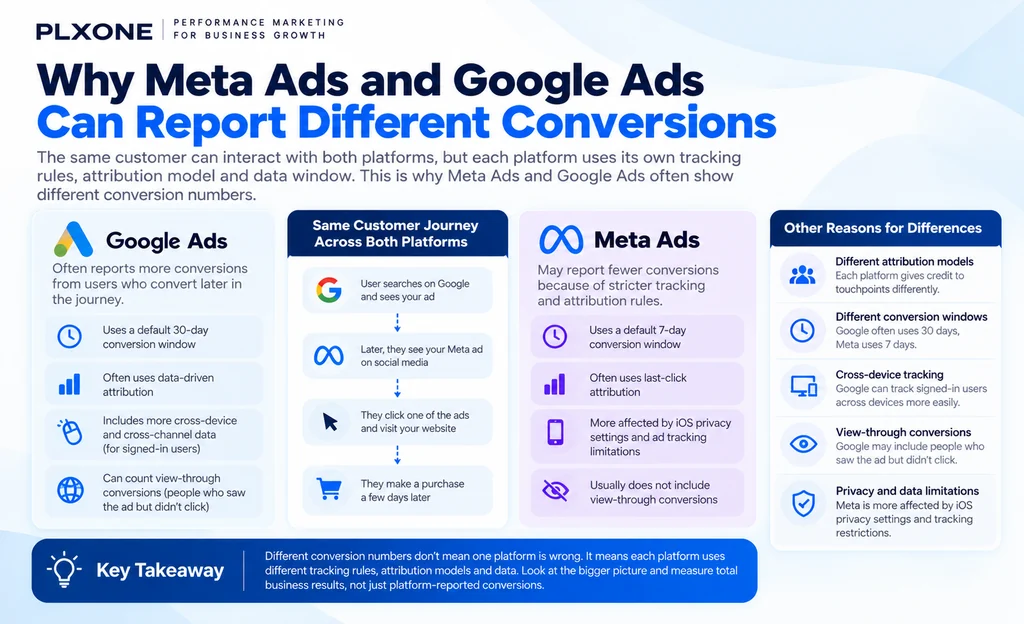
This is why advertising dashboards should inform your decisions, not make those decisions for you. Use the reports to understand campaign activity, then look at your actual orders, customer acquisition costs, and profitability before deciding where to invest more.
How Marketing Attribution Connects to CAC, ROAS, and Profitability
In the previous section, we saw why advertising platforms can report conversions differently from your store. But how does that affect the numbers you use to decide whether your marketing is working?
Let’s look at three metrics that matter to business owners: customer acquisition cost (CAC), return on ad spend (ROAS), and profitability.
Imagine your ecommerce business spends ₹50,000 on advertising and your store records 100 orders. For simplicity, assume 60 orders come from first-time customers and 40 come from returning customers.
Your advertising dashboard reports 100 purchases, but your goal is to acquire new customers.
First, consider customer acquisition cost (CAC).
If you divide ₹50,000 in advertising spend by 60 new customers, your advertising cost per new customer is approximately ₹833.

This is an advertising-only acquisition cost. A fuller CAC calculation may also include other acquisition expenses, such as agency fees, creative production, and relevant marketing salaries.
The distinction matters because dividing advertising spend by all 100 orders would give you ₹500 per order. That number looks lower, but it doesn’t tell you how much you spent to acquire new customers specifically.
Next, consider return on ad spend (ROAS).
Suppose the 100 orders generate ₹1,00,000 in revenue. Your reported ROAS would be:

That means ₹2 in reported revenue for every ₹1 spent on advertising.
But attribution matters here, too. If the ₹1,00,000 comes from platform-attributed revenue rather than verified store revenue, the result may not represent the same set of sales. Different platforms may also claim credit for overlapping purchases.
Finally, consider profitability.
Even if the store genuinely generates ₹1,00,000 in revenue, you still need to account for product costs, shipping, discounts, and other relevant expenses. A ROAS of 2 doesn’t automatically mean the campaign is profitable.
This is where the three metrics work together. Attribution helps you understand how sales are credited across marketing channels. CAC helps you evaluate the cost of acquiring customers. ROAS compares attributed revenue with advertising spend, while profitability shows whether enough money remains after relevant costs.
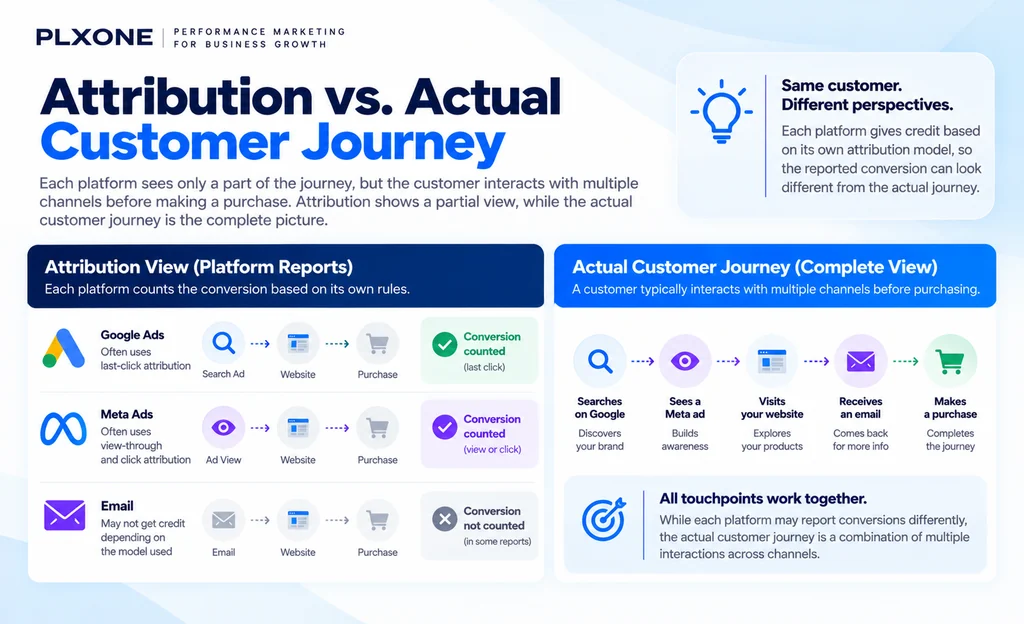
None of these metrics should be interpreted in isolation.
For example, a campaign might report strong ROAS because it receives credit for purchases from customers who already know your brand. If your objective is new-customer growth, you need to investigate how many first-time buyers you’re actually acquiring and what those customers cost.
The business decision isn’t simply which channel reports the highest ROAS. It’s whether your marketing is bringing in the customers you want at a cost your business can sustain.
Attribution gives you one part of that picture. Your customer data, acquisition costs, and profitability calculations help you understand the rest.
How to Use Attribution to Make Better Marketing Decisions
Knowing how attribution works is one thing. Deciding what to do when the numbers don’t give you a clear answer is another.
Imagine your skincare business has been running Meta Ads and Google Ads for several months. One month, Google Ads reports more conversions than Meta Ads. Should you move more of your budget to Google immediately?
Not necessarily.
Before making that decision, consider what changed. Did Google bring in more first-time customers, or did more existing customers search for your brand? Did Meta’s performance actually decline, or are the platforms assigning credit differently? Is the difference large enough to justify changing your strategy?
You don’t need to answer every question at once. Start with the one that could most affect your next decision.
- Sometimes, the right decision is to wait.
If the difference is based on a few days of results or a small number of purchases, changing the budget immediately may be premature. Give yourself enough reliable data to understand whether you’re seeing a meaningful change or simply a short-term fluctuation.
- Sometimes, the right decision is to investigate.
If reported conversions change unexpectedly, check whether campaign settings, tracking, attribution windows, or customer behaviour have changed. Don’t assume the advertising itself is responsible before examining the evidence.
- And sometimes, the right decision is to test.
Suppose you’re unsure whether retargeting ads are generating additional purchases or mainly reaching people who were already likely to buy. Where practical, a controlled experiment can help investigate that question more directly than comparing attributed conversions alone.
The important thing is to match your response to the evidence available. Not every reporting difference requires a campaign change, and not every uncertainty can be resolved by looking at another dashboard.
For business owners, this is where attribution becomes genuinely useful. It helps identify questions worth investigating, while a disciplined approach to testing and measurement helps you avoid making expensive decisions based on assumptions.
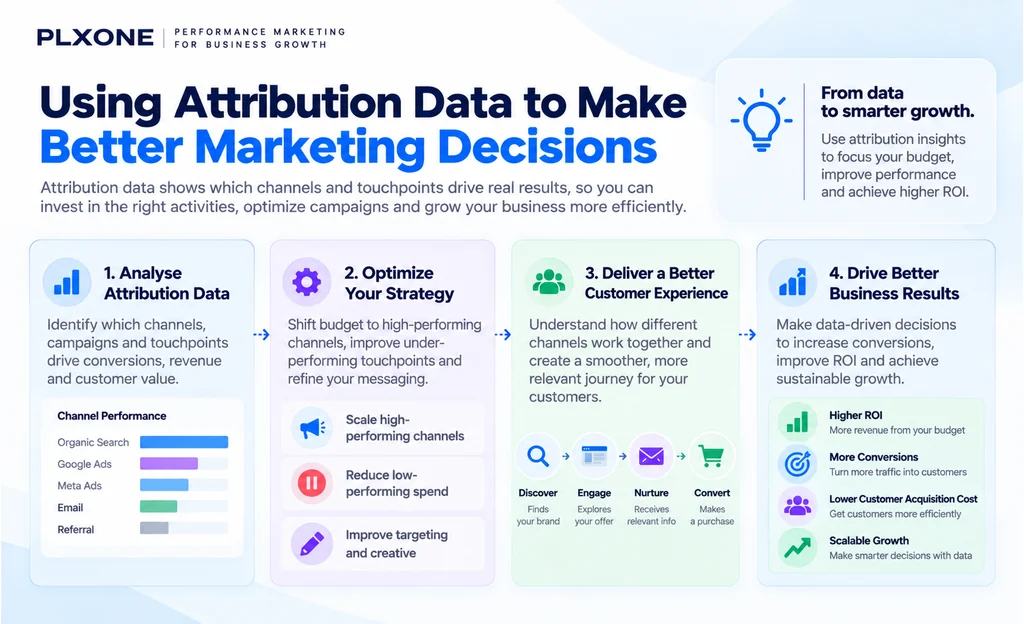
Don’t change your marketing simply because a report looks different. Understand what changed, investigate what matters, and act when the evidence supports a decision.
The PLXONE Perspective on Marketing Attribution
At PLXONE, we believe marketing should be treated as an investment in business growth, not simply as an expense that generates clicks and sales.
That’s why we don’t look at marketing attribution in isolation. Knowing which channel receives credit for a conversion is useful, but it doesn’t tell you whether the business is acquiring customers sustainably, generating enough contribution, or making the best use of its marketing budget.
Our philosophy is simple: measure the results, understand what’s driving them, and make decisions based on business outcomes—not assumptions.
This means looking beyond individual campaign dashboards and connecting the different parts of marketing performance.
- Strategy: Understand what the business wants to achieve before deciding which numbers matter.
- Traffic: Evaluate whether marketing is reaching relevant potential customers.
- Digital Experience: Examine what happens after people click an ad and arrive on the website.
- Conversion: Understand whether visitors are turning into customers.
- Customer Experience: Consider whether the business is building relationships that can lead to repeat purchases.
- Analytics and Measurement: Connect campaign reporting with customer data, acquisition costs, and profitability to make better-informed decisions.
These areas work together. A campaign may attract relevant visitors, but a poor website experience can prevent purchases. A channel may receive credit for sales, but the business still needs to understand the cost of acquiring those customers and the contribution those sales generate.
Attribution helps us investigate one part of this system. It doesn’t replace the wider analysis needed to understand business growth.
We also recognise that marketing data has limitations. Not every customer interaction can be tracked, and no attribution model can tell us with certainty what would have happened without a particular ad. Good decisions require us to question the numbers, investigate gaps, and acknowledge what the available evidence cannot establish.
At PLXONE, our objective isn’t to make marketing reports look better. It’s to help businesses understand their growth, identify what needs attention, and invest more intelligently.
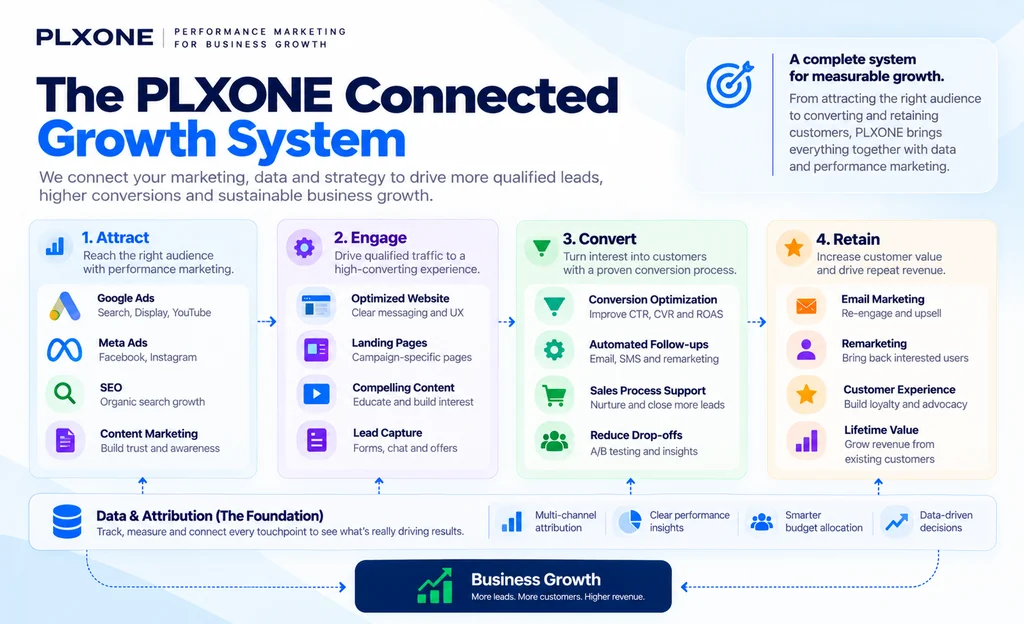
Because sustainable growth doesn’t come from giving marketing channels more credit. It comes from building a marketing system in which strategy, customer acquisition, conversion, customer experience, and measurement work together to support business outcomes.
Marketing Attribution Is About Better Business Decisions
A marketing dashboard can tell you which channel received credit for a sale. But that alone doesn’t tell you whether your marketing investment is helping your business grow.
As we’ve seen, the same purchase can be attributed differently depending on the model and reporting system. That’s why business owners need to look beyond individual platform reports and understand what the numbers actually mean.
The real value of marketing attribution is not in finding a channel that looks best on a dashboard. It’s in using the available evidence to ask better questions, investigate performance, and make more informed decisions about where to invest.
At PLXONE, we believe sustainable growth comes from treating marketing as a connected system. Strategy, traffic, digital experience, conversion, customer experience, and analytics all influence how effectively marketing supports business outcomes.
Before you spend more, understand what your marketing is contributing, where the gaps are, and what needs to improve. That’s how measurement becomes more than reporting—and how marketing decisions become more purposeful.
FAQ
What is marketing attribution?
Marketing attribution is a way to assign credit to the marketing interactions associated with a conversion. It helps businesses understand how channels such as Google Ads, Meta Ads, and organic search appear in the customer journey.
Why is marketing attribution important?
Marketing attribution helps businesses interpret campaign performance and make more informed marketing investment decisions. It provides useful context about customer interactions, although it cannot independently prove which interaction caused a purchase.
What are the main types of marketing attribution models?
Common models include first-touch attribution, which credits the first recorded interaction; last-touch attribution, which credits the final interaction; and multi-touch attribution, which distributes credit across multiple interactions.
Why do Meta Ads and Google Ads report different conversions?
The platforms may use different attribution settings, reporting windows, and tracking methods. They may also assign credit to the same purchase. Comparing their reports with actual store orders helps businesses understand these differences.
How does marketing attribution help improve profitability?
Attribution helps businesses interpret how marketing channels receive credit for sales. When combined with customer acquisition cost, advertising spend, revenue, and relevant business costs, it supports better-informed decisions about marketing investment. Attribution alone does not establish profitability.
Pingback: Customer Acquisition Cost (CAC): How to Calculate It|PLXONE
Pingback: ROAS vs Profitability: Does High ROAS Mean More Profit?