
You can run Meta Ads, generate sales, and still struggle to acquire customers consistently.
The difficult part isn’t always getting more sales. It’s understanding whether your campaigns are bringing in the right customers and what needs to change when results don’t meet expectations.
Increasing the budget is an easy decision to make. Knowing whether to change your audience, offer, campaign structure, or website experience requires a closer look at what’s actually happening.
That’s where customer acquisition strategy matters. Meta Ads shouldn’t operate as an isolated advertising activity. The decisions you make before launching a campaign, the experience customers have after clicking an ad, and the way you evaluate results all influence how effectively you acquire new customers.
In this article, we’ll look at how to approach customer acquisition through Meta Ads from a business-growth perspective—not simply how to run another campaign.
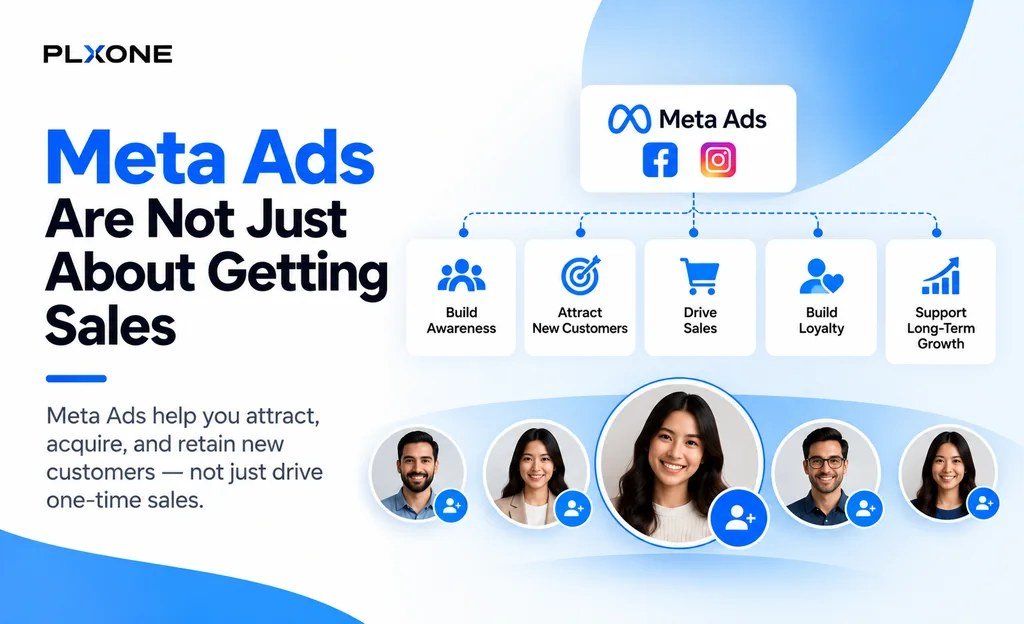
Meta Ads Are Not Just About Getting Sales
Getting sales from Meta Ads is encouraging, but sales alone don’t tell you whether your customer acquisition strategy is working.
Consider an ecommerce business that spends ₹50,000 on Meta Ads and generates ₹1,00,000 in sales from 100 orders.
At first glance, the campaign looks promising. For every ₹1 spent on advertising, the business generates ₹2 in revenue. But revenue isn’t the same as profit.
Suppose the products sold cost ₹45,000, while shipping and other variable expenses add another ₹15,000. After accounting for these costs and the ₹50,000 advertising spend, the business is left with a ₹10,000 loss before fixed overheads and taxes.
This is the kind of calculation a business needs to make before deciding whether to increase its advertising budget. The campaign generated orders, but the money coming in wasn’t enough to cover the costs in this example.
My own experience with Google Ads reinforced an important lesson for me: advertising spend doesn’t guarantee business results. I spent approximately ₹2.5 lakh on Google Ads and generated around ₹95,000 in revenue. Looking back, I believe the bidding strategy and targeting were wrong, and I eventually stopped the campaigns.
That experience is a reminder to investigate what is happening before putting more money into advertising. The numbers can show that something isn’t working, but understanding why requires a closer look at the decisions behind the campaign.
And profitability is only one part of the picture. If the goal is to grow the customer base, there’s another question to answer: how many of those orders came from people buying for the first time, rather than customers who had purchased before?
Are Your Meta Ads Bringing in New Customers?
An increase in orders doesn’t always mean a business is acquiring customers at the same rate.
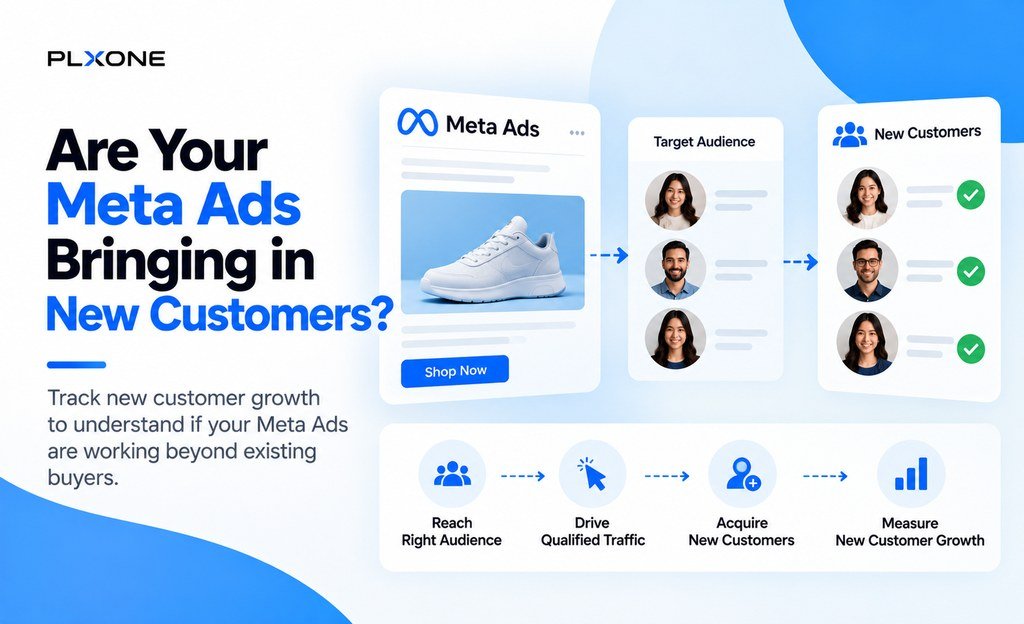
Some purchases may come from people discovering the brand for the first time. Others may come from customers who have bought before, visited the website, or interacted with the brand on Instagram.
Meta Ads can support both outcomes. Ads aimed at new prospects can help introduce a business to potential customers, while retargeting can encourage people who already know the brand to return and purchase. Both can contribute to business growth, but they serve different purposes.
The distinction becomes important when a business decides whether its acquisition strategy is working. If the goal is to expand the customer base, total purchases don’t tell the whole story. The business needs to understand how many buyers are new and how many are returning.
One practical way to investigate this is to compare first-time and repeat orders in the store’s customer data with the results reported by Meta Ads. The figures may not match exactly because the systems use different attribution methods, but together they provide a more useful picture than looking at attributed purchases alone.
This distinction also changes how you interpret campaign results. A campaign that brings existing customers back may be valuable, but it shouldn’t automatically be treated as evidence that new-customer acquisition is improving.
Before deciding whether to scale, understand both what your advertising is generating and who is actually buying. That gives you a clearer basis for deciding what your customer acquisition strategy needs next.
More Reach Doesn’t Always Mean More Customers
When customer acquisition isn’t growing as expected, reaching more people can seem like the obvious solution. But a larger audience doesn’t automatically mean more potential buyers.
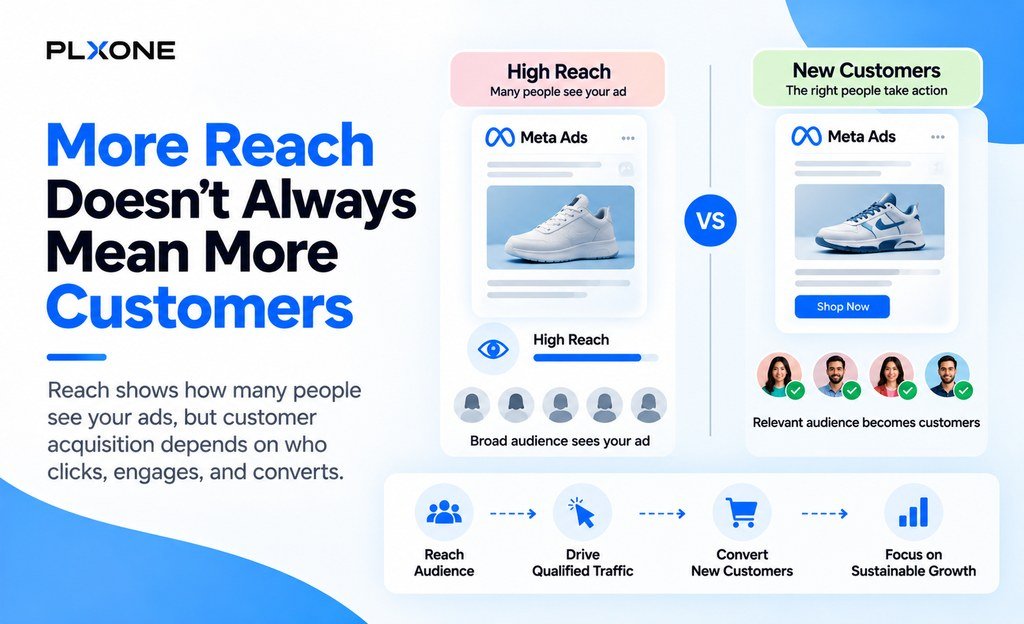
Consider an ecommerce business selling premium skincare products. Its ads might reach people across different age groups, genders, and locations. Yet not everyone reached will need the product, see value in its price, or be able to buy from the business.
This is where audience decisions need more thought than simply selecting demographic characteristics in Meta Ads.
Age and gender may be relevant for certain products, while location can determine whether the business can deliver to a customer at a reasonable cost. Interests and other audience signals can also inform targeting, but they don’t guarantee that someone intends to buy.
Meta’s audience settings matter, too. Depending on the campaign setup, some selections may guide delivery rather than strictly restrict it. With Advantage+ audience, for example, certain inputs can function as suggestions that Meta uses to find additional people. Businesses need to understand their actual campaign settings rather than assume every selection acts as a fixed boundary.
The business also needs to test its assumptions against real results. Which audiences are generating first-time purchases? Are those customers buying at a cost the business can sustain? And are the results consistent enough to justify changing the targeting or increasing spend?
These questions help turn audience selection from guesswork into a decision-making process. The objective isn’t to find the largest audience or the most narrowly defined one. It’s to reach people who are relevant to the product, can be served by the business, and have a plausible reason to buy.
More reach creates an opportunity. Understanding who becomes a customer tells you whether that opportunity is worth pursuing.
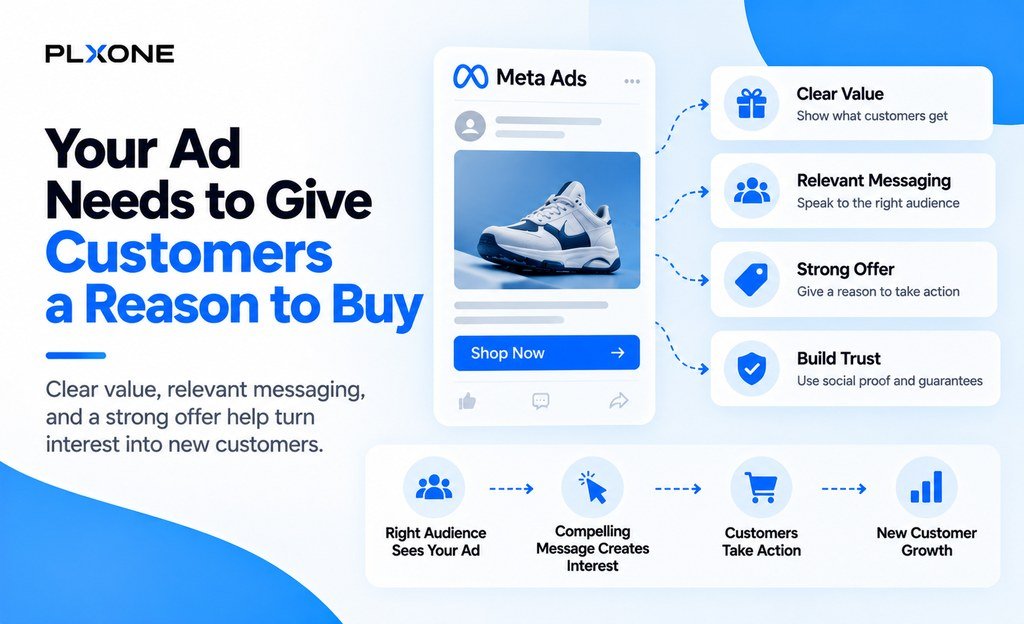
Your Ad Needs to Give Customers a Reason to Buy
Reaching people who might need your product is one thing. Giving them a reason to choose your business is another.
Think about a customer looking at two similar skincare products. Both claim to support healthy skin, and both are advertised on Instagram. Why should the customer choose one over the other?
The answer isn’t necessarily a more attractive ad or a bigger discount. It could be a benefit that matters to the customer, an offer that makes the purchase worthwhile, or a clear explanation of why the product suits their needs.
This is where many acquisition decisions need to go beyond the ad itself. A business may know its product well, but that doesn’t mean a potential customer immediately understands its value. The ad needs to bridge that gap.
The same applies to discounts. A lower price may make an offer more attractive, but it can also reduce the contribution earned on each order. If a discount is the only reason people buy, the business needs to understand whether those sales support its acquisition economics.
The message also needs to match the experience that follows. If an ad promises a particular benefit but the product page doesn’t explain it clearly, the customer is left to make sense of the offer alone. That disconnect can weaken the buying decision even when the ad attracts attention.
For a business acquiring customers through Meta Ads, the important question is not simply whether an ad gets noticed. It’s whether the product, offer, and message give the intended customer a convincing reason to buy.
An ad can earn attention, but the value of the offer is what gives a customer a reason to consider buying.
How Do You Know Which Meta Ads Are Actually Acquiring Customers?
A campaign dashboard can show purchases, cost per purchase, and reported return on ad spend. These numbers are useful, but they don’t automatically tell you how much your business has grown.
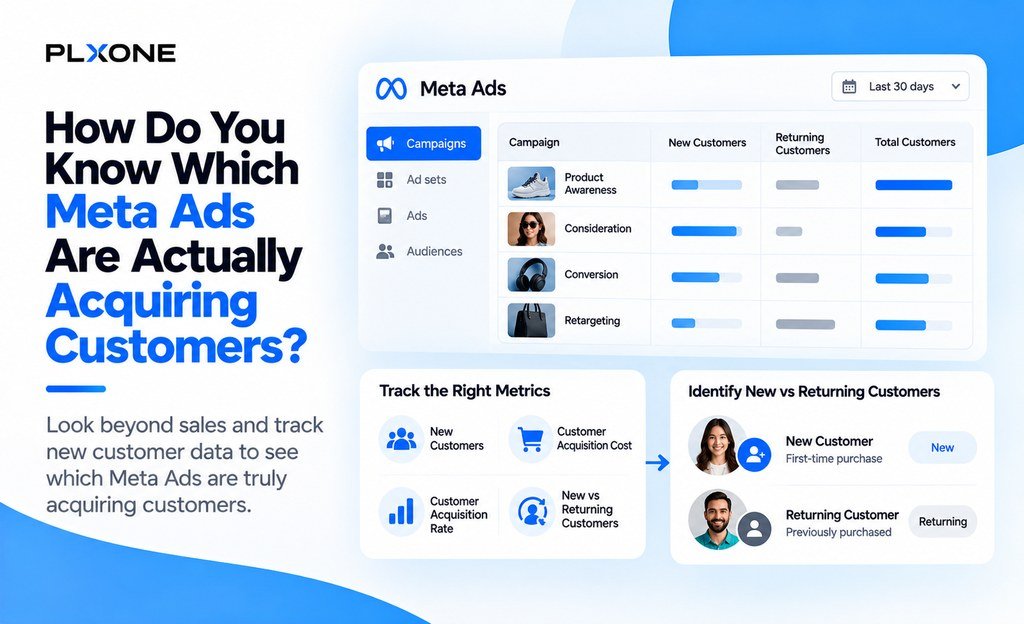
For example, Meta Ads may attribute a purchase to an ad when the customer has interacted with that ad before buying. That doesn’t necessarily mean the ad was the only reason the customer purchased. The customer may already have known the brand, visited the website, or been considering the product.
This is why campaign reporting needs to be read alongside your store’s actual order and customer data. Look at how many first-time customers you’re acquiring, how much you’re spending to acquire them, and whether the sales generated leave enough contribution after the relevant costs.
Your numbers may differ between Meta Ads and your store because attribution methods and reporting windows can differ. Rather than expecting every figure to match perfectly, understand what each system measures and use consistent definitions when comparing performance.
Your objective also matters. If you’re trying to acquire new customers, total purchases and reported ROAS shouldn’t be the only measures of success. If you’re trying to bring existing customers back, repeat purchases may be relevant to that separate goal.
The important thing is to connect campaign reporting to the business outcome you’re trying to achieve. Without that connection, it’s easy to mistake attributed sales for incremental growth.
Measure what the campaign reports, verify what happened in your business, and then decide what the results actually mean.
What If Your Meta Ads Aren’t Bringing in Enough New Customers?
A new customer places an order after seeing your Meta Ad. That’s a sale you can measure. But is that customer worth acquiring at the cost you paid?
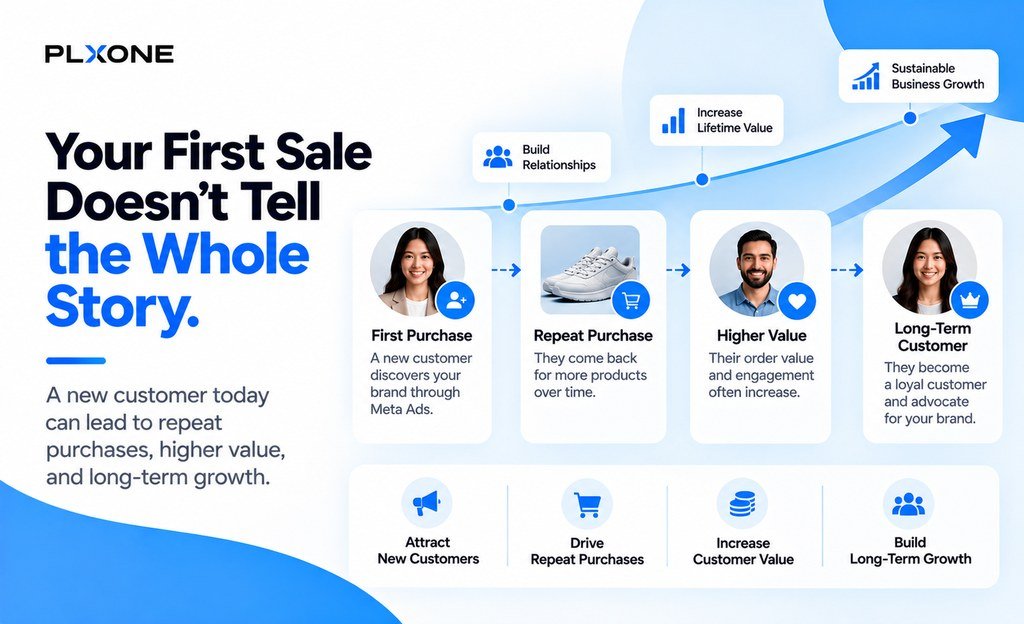
The answer depends partly on what you’re selling.
Consider a skincare brand selling a face cleanser for ₹600. A customer buys it after seeing an ad. If they like the product and finish it in a few weeks, they may buy it again. The brand has an opportunity to generate more business from that customer without having to acquire a completely new customer for every order.
Now consider a business selling a ₹3,000 office chair. A customer may use it for years before needing another one. The business might not see a repeat purchase from that customer anytime soon.
Both businesses can acquire customers through Meta Ads, but the economics of those customers may be very different.
For the skincare brand, the first order may not tell the whole story. Repeat purchases could make the customer more valuable over time. For the chair business, the initial purchase economics may carry more weight because another order from the same customer could be a long way off.
But there’s a catch: a possible repeat purchase isn’t the same as an actual repeat purchase. The skincare customer might switch brands, and the chair buyer might recommend the product to someone else. Neither outcome should be assumed when deciding how much to spend on acquisition.
The business needs to examine its own customer data. Are buyers returning? How long does it take them to purchase again? And after accounting for product and fulfilment costs, how much additional contribution do those repeat orders generate?
That information helps a business understand what it can reasonably afford to invest in acquiring new customers. It also prevents two costly mistakes: judging every customer only by their first order, or assuming future purchases will automatically make an expensive acquisition worthwhile.
Don’t base your acquisition decisions on the assumption that customers will return. Understand whether they do—and what those relationships are actually worth to your business.
When Should You Increase Your Meta Ads Budget?
A campaign generating sales is encouraging. But before increasing the budget, you need to know whether those sales justify putting more money into advertising.
Start with the economics of acquiring a new customer. What does it cost to bring in a first-time buyer, and how much contribution remains after the product cost, discounts, shipping, and advertising? A campaign can report a healthy volume of purchases while leaving the business with little room to cover its other expenses.
Next, look at consistency. One strong day—or even a short run of good results—doesn’t tell you enough about how a campaign will perform with more spend. You need reliable tracking and enough meaningful results to judge whether the current performance is repeatable.
Then consider what happens when you spend more. A higher budget doesn’t guarantee that customer acquisition will grow at the same rate or cost. Results can change as delivery expands, so the business needs to evaluate the additional customers and the economics behind them, not just the increase in sales.
This is where discipline matters. Increasing spend should be a decision based on what you know about your acquisition costs, customer quality, and business margins—not simply a reaction to a campaign that looks successful in the dashboard.
After making an increase, compare the new results with your previous performance. Did you acquire more first-time customers? Did acquisition costs remain sustainable? Did the additional sales contribute enough to justify the extra spend?
The right time to scale is when the evidence supports further investment—not simply when the campaign starts generating sales.
What Should You Test Before Scaling Meta Ads?
Running Meta Ads involves making decisions with incomplete information. You may have a clear offer and a relevant audience, but you won’t know exactly how people will respond until your campaigns generate results.
The challenge is to learn from those results without spending blindly.
Suppose you’re running two ads for the same product. One generates more clicks, while the other generates fewer clicks but more purchases. If you judge performance by clicks alone, you could favour the ad that contributes less to customer acquisition.
This is why every test needs a clear purpose. Before launching one, decide what you’re trying to learn and which outcome will help you make that decision. Are you comparing two messages, evaluating different creative formats, or trying to understand whether an offer influences purchases?
Keep the comparison as clear as practical. If you change the audience, creative, offer, and landing page all at once, it becomes harder to identify what influenced the result. Some experiments require multiple changes, but you should still understand what you’re comparing and what conclusions the available data can support.
The amount of data matters, too. A handful of purchases may be encouraging, but it may not be enough to establish that one approach consistently performs better. Avoid declaring a winner simply because one ad leads on a small or uneven sample.
Most importantly, decide what success means before you interpret the results. More clicks may indicate stronger interest, but they don’t necessarily mean better customer acquisition. Where the data allows, evaluate purchases, first-time customers, and the economics behind those purchases.
The purpose of testing isn’t to prove that one ad is better in every situation. It’s to reduce uncertainty, understand what influences results, and make the next campaign decision with better evidence.
Test to learn something specific—not simply to keep changing ads.
The PLXONE Perspective on Customer Acquisition
Acquiring customers through Meta Ads isn’t simply about reaching more people, generating more orders, or increasing your advertising budget. It’s about understanding what brings the right customers to your business and whether acquiring them makes commercial sense.
That requires looking beyond the campaign dashboard. You need to understand who you’re reaching, why they might buy, what happens after the first purchase, and whether your results justify further investment.
Not every campaign will work as expected. What matters is how you respond: examine the evidence, identify what needs attention, test your assumptions, and use what you learn to make better decisions.
At PLXONE, we believe advertising should be evaluated as an investment in business growth—not just as a way to generate sales. The goal is to build a customer acquisition approach that supports sustainable growth, rather than spending more simply to chase bigger numbers.
FAQ
What is customer acquisition strategy?
A customer acquisition strategy is a plan for attracting and converting new customers in a way that supports business growth. With Meta Ads, it involves choosing the right audience, communicating product value, measuring results, and evaluating whether acquiring customers is commercially sustainable.
How can Meta Ads help acquire new customers?
Meta Ads can help businesses reach potential customers on Facebook and Instagram through relevant advertising, compelling offers, and creative messaging. Businesses should measure how many first-time customers they acquire rather than judging performance only by total purchases.
How do you measure customer acquisition from Meta Ads?
Measure new customers, customer acquisition cost (CAC), and the revenue and contribution generated by those customers. Compare Meta Ads reporting with your store’s order and customer data to distinguish first-time buyers from returning customers.
When should you increase your Meta Ads budget?
Increase your budget when tracking is reliable, results are sufficiently consistent, and customer acquisition costs and profitability support further investment. After increasing spend, evaluate whether new-customer growth remains sustainable.
Why can Meta Ads generate sales without profitable growth?
Sales do not automatically mean profit. Product costs, discounts, shipping, advertising spend, and other variable expenses can reduce or eliminate the contribution from orders. Businesses need to evaluate these costs alongside customer acquisition results before scaling.
Pingback: Customer Acquisition Cost (CAC): How to Calculate It|PLXONE
Pingback: Performance Marketing Guide: Profitable Growth | PLXONE