
One of the first questions businesses ask before starting Google Ads is simple:
“How much will it cost me?”
The honest answer is: there is no fixed price for Google Ads.
You can choose a daily budget, but what you actually spend—and what you get from that spend—depends on several factors. The keywords you target, competition in your market, the relevance of your ads, your landing page, bidding strategy, and the action you want customers to take can all influence the economics of a campaign.
I learned this lesson the hard way. While running my business, I lost some of my hard-earned money on Google Ads because I didn’t have a deep enough understanding of how the platform and its economics worked. That experience taught me that before putting more money into advertising, you need to understand what you’re paying for, what you’re measuring, and whether the numbers make sense for your business.
But there is another question that can be more important than the cost of running the ads:
“What does it cost my business to acquire a customer?”
A campaign can generate clicks at a reasonable cost and still be a poor business decision if those clicks don’t turn into valuable customers. On the other hand, a higher cost per click may make sense when the customers acquired generate enough revenue and long-term value to support that investment.
That’s why understanding Google Ads cost isn’t simply about knowing the price of a click. It’s about understanding what drives the cost, what you’re paying for, what you’re getting in return, and whether the economics make sense for your business.
In this guide, we’ll break down how Google Ads costs work, what influences them, how budgets and bidding affect spending, and how to evaluate Google Ads from a business-growth perspective.
How Google Ads Pricing Works
When I first started running Google Ads for my business, I looked at the cost of advertising mainly from the platform’s perspective: how much was I spending and how many clicks was I getting? I learned later that this was only one part of the equation.
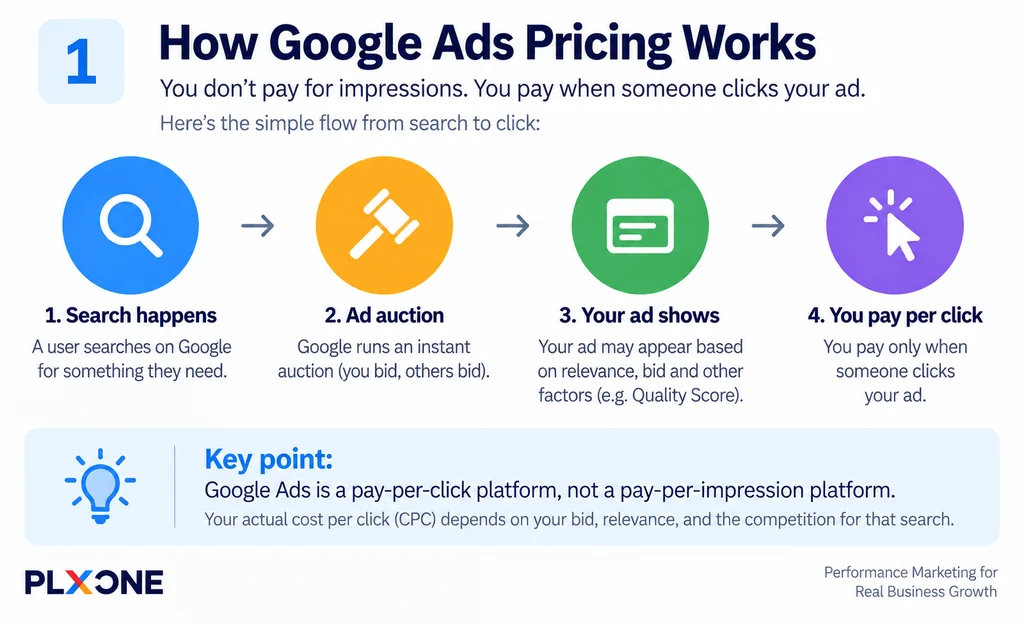
Google Ads doesn’t charge businesses a fixed amount to advertise. Instead, the amount you pay depends on factors such as the advertising format, competition for the audience or search term, bidding, and the actions you want to generate.
For Search campaigns, businesses commonly pay when someone clicks an ad. This is known as cost per click (CPC). But the amount you pay for a click isn’t necessarily the same for every search or every business. Competition, ad relevance, bidding strategy, and the overall user experience can all influence what a click may cost.
This is why asking “How much does Google Ads cost?” doesn’t have one universal answer.
A business might spend ₹500 per day, ₹5,000 per day, or much more. The important question isn’t simply how much money is available to spend. It is whether the amount being spent can generate customers at an acquisition cost that makes sense for the business.
For example, suppose two businesses each spend ₹50,000 on Google Ads. One acquires 100 customers, while the other acquires only 20. Their advertising spend is identical, but their customer acquisition economics are completely different.
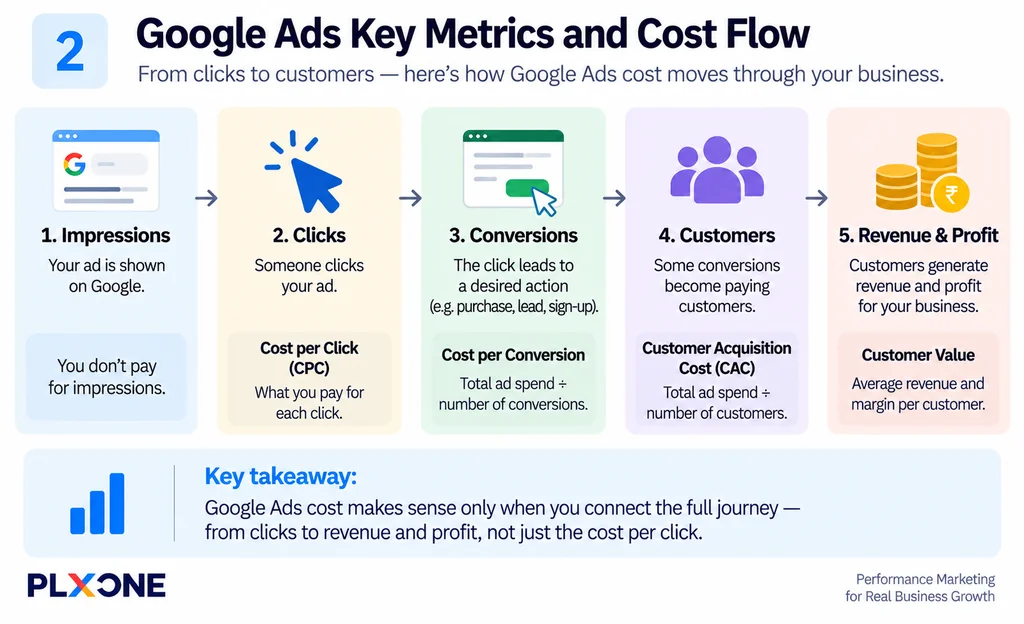
That is why Google Ads cost should be understood at more than one level:
- Ad cost — what you pay for clicks or other advertising interactions.
- Campaign spend — how much the campaign actually spends over a period.
- Cost per conversion — how much it costs to generate a desired action.
- Customer acquisition cost — what it costs the business to acquire a customer.
- Customer value — what those acquired customers are worth to the business over time.
The first tells you what you’re paying the advertising platform. The others help you understand whether that spending is creating a viable business outcome.
The cost of a click is only the beginning of the calculation.
What Determines Google Ads Cost?
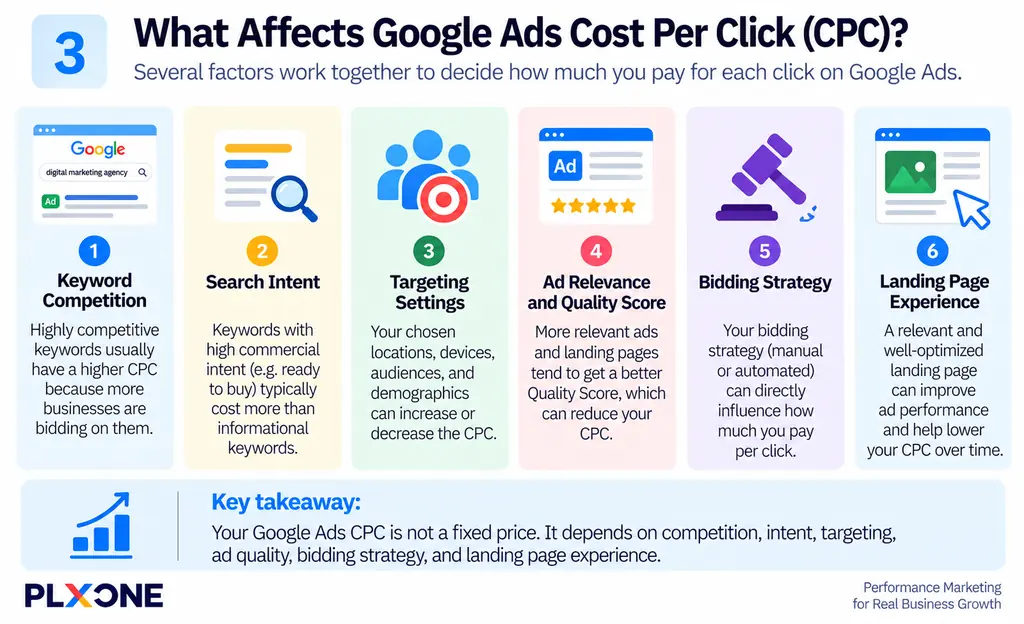
Google Ads cost is influenced by more than the keyword you choose. The amount a business pays can change based on the market, the competition, the quality of the ad experience, and how the campaign is managed.
From my own experience, I learned that simply choosing a keyword and setting a budget doesn’t tell you whether the campaign will be economical. The same amount of money can produce very different results depending on what you’re advertising, who you’re targeting, and what happens after someone clicks the ad.
Some of the main factors that can influence Google Ads cost include:
1. Keyword Competition
When multiple businesses compete for the same search terms, the cost of advertising can increase. Highly commercial searches can attract strong competition because multiple businesses are trying to reach people who are closer to making a purchase or taking another valuable action.
2. Search Intent
Not every search has the same commercial value.
Someone searching for “what is running shoes” is at a different stage from someone searching for “buy running shoes online.”
The second search may have stronger purchase intent, which can affect both competition and the potential value of the traffic.
3. Ad Relevance and Quality
Google considers the relevance and quality of the advertising experience when determining how ads compete in the auction.
Your keyword, ad, landing page, and the user’s search should make sense together.
A business shouldn’t think about this only as a way to reduce CPC. A more relevant experience can also help bring the right visitors to the business.
4. Bidding Strategy
Google Ads provides different bidding approaches depending on the campaign objective.
You might optimize toward clicks, conversions, conversion value, or other outcomes.
The bidding strategy therefore needs to match what the business is actually trying to achieve.
5. Industry and Market
The economics of Google Ads can vary significantly between industries.
A business selling a ₹500 product and a business selling a ₹2 lakh service are operating with very different economics. The amount each business can reasonably spend to acquire a customer will therefore be different.
6. Landing Page and Conversion Experience
Getting someone to click the ad is only part of the process.
If the landing page is confusing, slow, poorly matched to the advertisement, or makes it difficult to take the next step, the business can end up paying for traffic without generating enough conversions.
That’s why I don’t look at Google Ads cost in isolation.
The real question is not simply, “How much does a click cost?” It is, “What does it cost us to turn that click into a valuable customer?”
What I Learned From Spending ₹2.5 Lakh a Month on Google Ads
When I first set up Google Ads for my own business, I made a mistake that can be expensive for any business owner.
Google presented me with an easy setup option, and I simply followed the recommended setup. The campaign was created as a Performance Max campaign, allowing the ads to run across multiple Google channels and surfaces, including Search, YouTube, Display, and others.
At the time, I didn’t have enough depth of knowledge about Google Ads to understand the implications of that setup.
We were spending around ₹2.5 lakh per month on Google Ads.
But the results were nowhere close to making that spending economical.
We were getting roughly 10–15 clicks per day, or around 300–450 clicks per month. Those clicks resulted in only around 10–15 conversions per month.
That meant our advertising spend worked out to approximately ₹16,667–₹25,000 per conversion.
The revenue generated from those campaigns was only around ₹15,000–₹20,000 per month against approximately ₹2.5 lakh in advertising spend.
In simple terms, the numbers didn’t make business sense.
Looking back, I identified fundamental problems with the bidding strategy and targeting. I had focused on getting the campaign running without first understanding whether the campaign structure, targeting, bidding approach, and economics were appropriate for my business.
Eventually, we stopped running Google Ads.
What Did I Learn?
The biggest lesson wasn’t that Google Ads was expensive.
It was that spending money on an advertising platform without understanding the underlying economics can make the cost much higher than the budget you originally planned.
A large advertising budget cannot compensate for the wrong targeting or bidding approach.
Before increasing the budget, understand the system.
Before optimizing the campaign, understand what you’re trying to achieve.
And before judging whether Google Ads is expensive, understand what a customer is worth to your business and how much you can afford to spend to acquire one.
This experience taught me that Google Ads cost should never be evaluated in isolation. It has to be evaluated against conversions, customer acquisition cost, revenue, and ultimately profitability.
What Is a Reasonable Google Ads Budget?
When I started running Google Ads for my own business, I didn’t have a fixed advertising budget.
The reason was simple: I didn’t know enough about Google Ads to determine what a reasonable budget should be.
My understanding at the time was straightforward: we needed to run Google Ads, Google would use whatever amount was required to run the advertising, and we would pay for what was spent.
I didn’t start by calculating how many customers we needed, what we could afford to pay to acquire a customer, or what level of advertising spend our business economics could support.
That was a mistake.
As we saw earlier, we eventually ended up spending around ₹2.5 lakh per month, while generating only around 10–15 conversions and ₹15,000–₹20,000 in monthly revenue from the campaigns.
The problem wasn’t simply that the budget became large. The bigger problem was that there was no business-based budget decision behind the spending.
Today, I would look at the question differently.
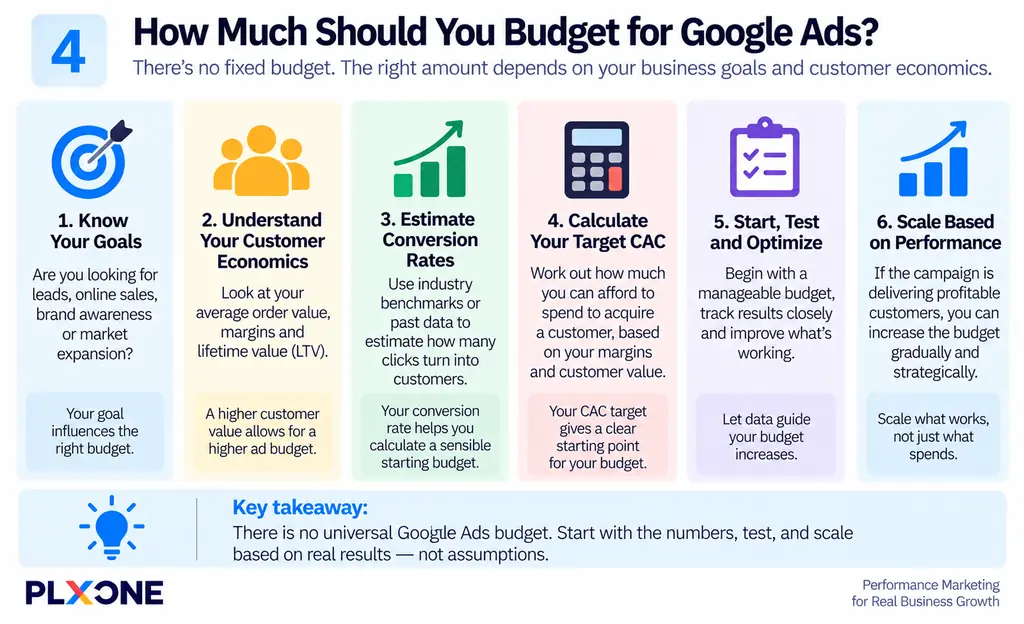
Before deciding how much to spend on Google Ads, a business should understand:
- What is the expected cost per click?
- How many clicks might be required to generate a conversion?
- What could the cost per conversion be?
- How many conversions are likely to become paying customers?
- What is each customer worth to the business?
- How much can the business reasonably afford to spend to acquire that customer?
This changes the question from:
“How much should I spend on Google Ads?”
to:
“How much can my business afford to spend to acquire a customer profitably?”
What Affects Google Ads Cost Per Click?
When I first started running Google Ads, I assumed that the cost of a click was mainly determined by the keyword I selected.
I later learned that it was more complicated.
Google Ads works through an auction. The amount you pay for a click can change depending on how competitive the search is, the value of that search to advertisers, how relevant the ad is, and how the campaign is being managed.
For example, consider these two searches:
“what are running shoes”
and
“buy running shoes online.”
Both are related to the same product, but the person making the second search has a much stronger buying intent. Advertisers may therefore place different values on these searches.
Competition can also change the economics. If many businesses are trying to reach the same potential customers, advertisers are competing for the same opportunities.
Then there is the relationship between the keyword, ad, and landing page. If these elements are closely aligned with what the person is searching for, the advertising experience is more relevant. If they are poorly matched, the campaign may struggle to turn the available traffic into useful results.
Bidding also plays an important role. Different bidding strategies are designed around different campaign objectives, so the approach used should make sense for what the business is actually trying to achieve.
This is why there isn’t one standard Google Ads cost per click.
Two businesses can advertise in the same market and still experience very different CPCs because their targeting, competition, ads, bidding approach, and customer journey are different.
Understanding what drives CPC is important—but CPC alone still doesn’t tell you whether the advertising is profitable.
From CPC to Cost Per Conversion
CPC is one of the easiest Google Ads numbers to look at.
You can open a campaign, see how much each click is costing, and quickly decide whether the number looks high or low.
But a click is not what the business ultimately wants.
The business wants someone to take an action.
That action could be making a purchase, submitting an enquiry, booking a call, filling out a form, or doing something else that has value for the business.
This is where cost per conversion becomes more useful.
For example, if a campaign spends ₹50,000 and generates 25 conversions, the average cost per conversion is:
₹50,000 ÷ 25 = ₹2,000 per conversion
Now you have a number that tells you more than CPC alone.
But even this number doesn’t tell you whether the campaign is working.
A ₹2,000 cost per conversion could be perfectly reasonable for one business and completely unworkable for another.
It depends on what that conversion represents and what happens after it.
If those 25 conversions are genuine customers who generate significantly more value than ₹2,000 each, the economics may work.
If they are low-value leads that rarely become customers, ₹2,000 may already be too expensive.
This is an important distinction because Google Ads measures the conversion you tell it to measure. The business has to determine whether that conversion actually creates value.
That’s also why I wouldn’t evaluate a Google Ads campaign by looking at CPC alone.
The journey is:
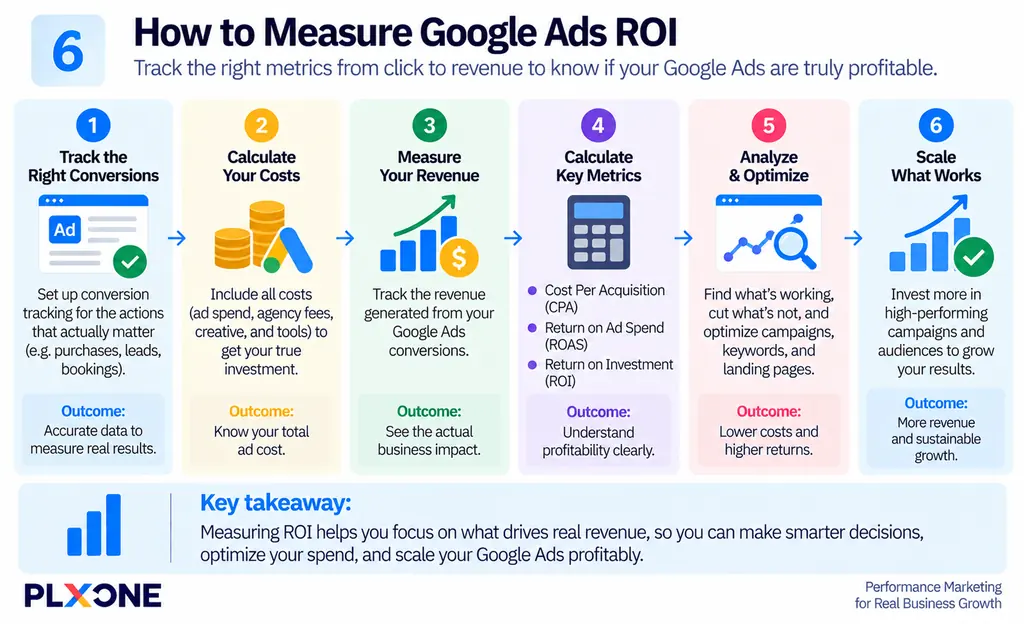
Click → Conversion → Customer → Revenue → Profit
The further you move along that journey, the closer you get to understanding whether your advertising spend actually makes business sense.
Google Ads Cost vs Customer Acquisition Cost
A conversion is not always a customer.
This is an important distinction that I didn’t understand when I first started running Google Ads.
Google may record a conversion when someone fills out a form, makes an enquiry, calls the business, or completes another action you’ve defined. But the business still needs to turn that conversion into an actual customer.
That’s why cost per conversion and customer acquisition cost (CAC) are not necessarily the same thing.
For example:
- Google Ads spend: ₹50,000
- Conversions: 25
- Customers acquired: 10
The cost per conversion is ₹2,000.
But the advertising cost per acquired customer is ₹5,000.
That ₹5,000 is much more relevant when you’re trying to understand the economics of customer acquisition.
The calculation is straightforward:
CAC from advertising = Ad Spend ÷ Customers Acquired
But the real question comes next:
Can the business acquire customers at that cost and still make money?
That depends on what each customer is worth to the business, including revenue, margins, repeat purchases, and customer lifetime value.
This is why looking at Google Ads cost in isolation can be misleading.
CPC tells you the cost of the click. Cost per conversion tells you the cost of the measured action. CAC tells you what you’re spending to acquire the customer.
For a business, that last number is where advertising starts connecting directly to growth economics.
How to Know Whether Your Google Ads Cost Makes Sense
Knowing your CPC, cost per conversion, and CAC is useful. But none of these numbers, by themselves, tells you whether your Google Ads campaign makes financial sense.
The real test is what happens when you compare customer acquisition cost with the value and profitability of the customers you acquire.
For example, if it costs ₹5,000 to acquire a customer, you need to understand what that customer contributes to the business—not just how much revenue the first transaction generates.
A ₹5,000 CAC could be difficult to justify for a low-margin product with little repeat business. The same CAC could be sustainable for a business where customers generate significantly more value over time.
A simple example
Suppose a business spends ₹1,00,000 on Google Ads and acquires 20 customers.
That gives the business a CAC of ₹5,000.
Now imagine each customer generates ₹15,000 in revenue, but the business has a gross margin of 30%.
The gross profit generated per customer would be:
₹15,000 × 30% = ₹4,500
In this example, the business is spending ₹5,000 to acquire a customer who generates ₹4,500 in gross profit from that revenue.
The advertising may be generating customers and revenue, but the economics would still need to be examined carefully.
This is why revenue alone isn’t enough. You need to understand margin, repeat purchases, and customer lifetime value.
The calculation therefore moves beyond:
“How much did Google Ads cost?”
to:
“How much did it cost us to acquire the customer, and what value did that customer create?”
This is the part I missed when I first ran Google Ads.
I was focused on the advertising activity and the money being spent. I wasn’t working backwards from the economics of customer acquisition.
That experience taught me an important lesson:
Google Ads cost only makes sense when you evaluate it against the economics of the business—not as an isolated advertising number.
If the economics don’t work, increasing the budget simply increases the amount of money being spent without solving the underlying problem.
How to Reduce Google Ads Cost Without Chasing Cheap Clicks
One of the easiest mistakes in Google Ads is to look at a high CPC and immediately think:
“We need cheaper clicks.”
I understand that thinking because I used to look at advertising costs in a similar way.
But a cheaper click isn’t necessarily a better click.
Suppose you reduce your CPC from ₹100 to ₹60. That looks like a 40% improvement.
But what if the ₹100 clicks were bringing relevant prospects while the ₹60 clicks rarely converted?
You may have reduced the cost of traffic while making the campaign less valuable to the business.
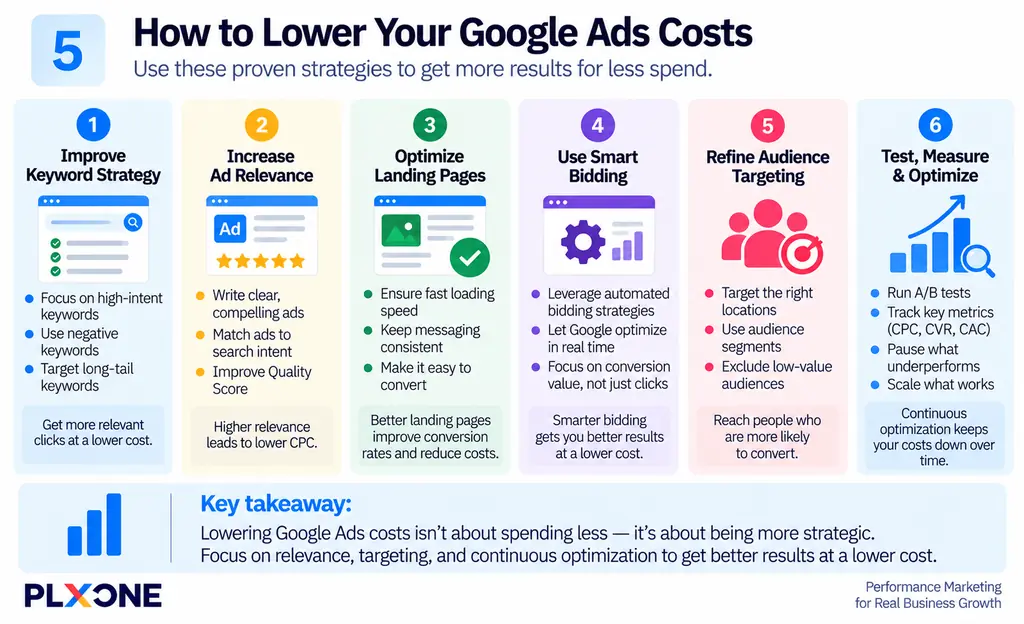
That’s why I wouldn’t start optimization by asking how to make clicks cheaper. I’d start by asking where the money is being wasted and why.
Are we targeting the right audience?
Are we paying for searches that have genuine business intent?
Does the ad match what the person is looking for?
Does the landing page continue the same message and make the next step clear?
And most importantly, are the people coming through the campaign actually becoming customers?
Sometimes the problem isn’t the price of the click. The problem is what we’re paying for.
This is also why I believe optimization should be a process rather than a series of random changes:
Measure → Identify → Investigate → Optimize → Measure again.
First understand what the numbers are telling you. Then identify where the problem is. Investigate why it is happening. Make a focused change. And measure again.
The objective isn’t to buy the cheapest traffic. It’s to make every rupee of advertising spend contribute more effectively to the business.
The PLXONE Perspective on Google Ads Cost
At PLXONE, we don’t look at Google Ads cost as “how much money should we spend?”
We look at it as a business investment that needs to make economic sense.
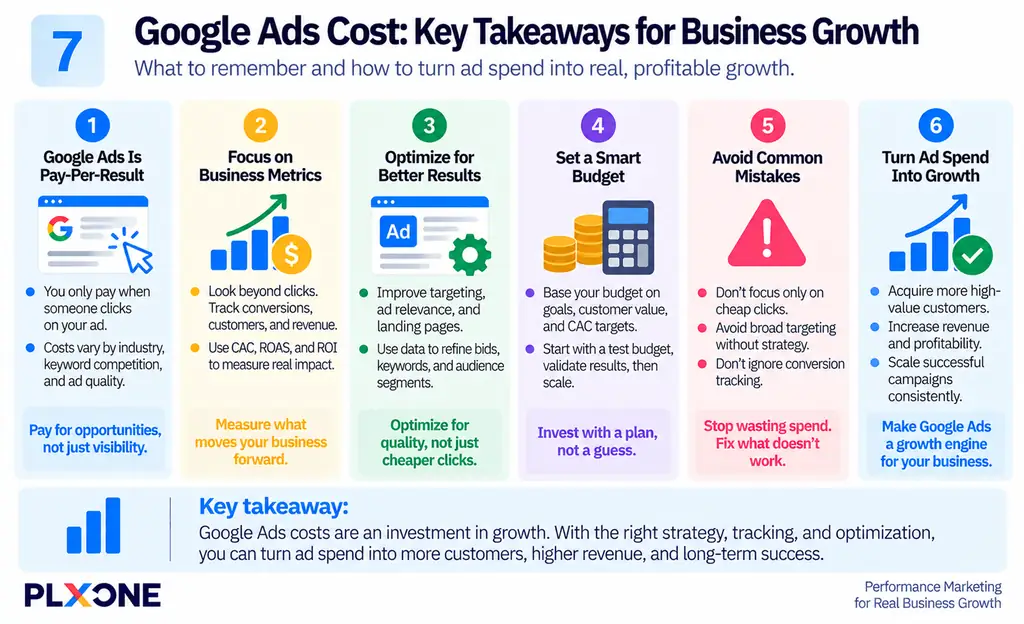
Before increasing the advertising budget, we want to understand a few simple things:
Who are we trying to reach?
What are we asking them to do?
How much does it cost to acquire a customer?
What is that customer worth to the business?
Does the money coming back justify the money going in?
This changes how we look at Google Ads.
We don’t consider a campaign successful simply because it gets clicks, generates conversions, or spends the entire budget.
The real measure is what that advertising activity contributes to the business.
Sometimes the answer may be to increase the budget because the economics work.
Sometimes the answer may be to change the targeting, bidding, offer, landing page, or conversion process.
And sometimes, as I learned from my own experience, the right decision may be to stop spending until the underlying problem is understood.
That is the approach we believe businesses should take with Google Ads:
Don’t start with the budget. Start with the business economics.
Don’t chase cheap clicks. Chase valuable customers.
And don’t scale advertising until you understand what is working and why.
FAQ
How much does Google Ads cost?
There is no fixed price for Google Ads. Your actual cost depends on factors such as competition, search intent, bidding, targeting, and the type of campaign you run.
More importantly, the cost should be evaluated against the customers and revenue generated from the advertising.
How much should I budget for Google Ads?
There is no universal budget that works for every business.
A sensible starting point depends on your customer economics, expected conversion rates, customer acquisition cost, and how much the business can afford to invest in acquiring customers.
Why is my Google Ads cost so high?
A high cost can have several causes, including strong competition, poor targeting, weak search intent, unsuitable bidding, or problems after the click.
The first step is to identify where the cost is increasing and why, rather than simply increasing or reducing the budget.
Is a lower CPC always better?
No.
A cheaper click isn’t necessarily valuable if it doesn’t come from the right audience or generate meaningful conversions.
The goal should be valuable traffic and customers, not simply the lowest possible CPC.
What is the difference between CPC, cost per conversion, and CAC?
CPC is the cost of getting a click.
Cost per conversion is the advertising spend divided by the number of conversions.
CAC is the cost of acquiring an actual customer.
These numbers can be very different, particularly for businesses where a conversion is a lead or enquiry rather than a completed purchase.
How do I know whether my Google Ads campaign is profitable?
You need to connect advertising spend with the economics of the customers you acquire.
Look at the relationship between:
Ad Spend → Customers → Revenue → Margin → Customer Value
A campaign generating conversions isn’t automatically profitable. The customers generated need to create enough value to justify the acquisition cost.
Can Google Ads be expensive for a business?
Yes, but the more useful question is whether the cost is sustainable for that particular business.
A ₹5,000 CAC can be difficult for one business and sustainable for another, depending on margins, customer value, repeat purchases, and lifetime value.
Should I increase my Google Ads budget if I’m getting good results?
Not automatically.
Before increasing the budget, understand why the campaign is working and whether the economics remain viable at a higher level of spending.
Scaling should follow understanding—not simply the availability of more budget.
Pingback: Performance Marketing Guide: Profitable Growth | PLXONE
Pingback: Customer Acquisition Cost (CAC): How to Calculate It|PLXONE